The short answer
To speak from your diaphragm, breathe in through your nose so your belly moves out and your shoulders stay still, then let the air flow out steadily as you talk, with your jaw and throat relaxed. The diaphragm powers the in-breath; the steady out-breath is what supports your voice. Learn it lying down with a hand on your belly, then sitting, then on a hiss, a buzz, counting and real sentences.
What the diaphragm actually does
The diaphragm is a dome-shaped muscle under your lungs. When you breathe in, it tightens and flattens, moving down towards your belly, and air flows into your lungs. When you breathe out, it relaxes and rises again (Cleveland Clinic). That is why your belly moves out on a low in-breath: the diaphragm is making room.
So the diaphragm’s main job is the in-breath. Your voice is made in your larynx, by the vocal folds vibrating as air flows out between them. You can’t literally speak “from” your diaphragm, or from your stomach.
What the phrase really means is two things:
- A low, relaxed in-breath that fills you from the bottom, with quiet shoulders and a quiet upper chest.
- A steady, supported out-breath. As you speak, the diaphragm gradually relaxes while your belly and rib muscles let the air go evenly. That keeps enough pressure under the vocal folds, so your throat doesn’t have to squeeze to make up for it.
An NHS speech and language therapy leaflet puts it this way: good abdominal breathing gives the voice enough air pressure and helps you avoid a strained or weak sound (Royal Berkshire).
Signs you’re speaking from your throat
- Your shoulders or upper chest rise when you breathe in before speaking.
- You run out of air before the end of a sentence and squeeze out the last words.
- You gasp, or take quick, noisy breaths in the middle of sentences.
- Your voice gets higher and tighter when you try to be louder.
- Your throat feels tired, dry or scratchy after a meeting or a long call.
- Your sentences trail off into a mumble or a creak.
- You hold your breath before speaking, then start with a little click or push.
One or two of these is normal under pressure. If several are your everyday pattern, breathing is the place to start, before resonance or pitch. Voice clinicians look at the same thing: whether breathing is mainly abdominal, in the chest, or up at the collarbones, and how well it lines up with speaking (ASHA). If your voice is often hoarse or speaking hurts, read the voice safety notes and see a professional.
How to speak from your diaphragm, step by step
Learn it in this order. Spend a day or two on each step, longer if it doesn’t feel easy yet. If you feel light-headed at any point, stop and breathe normally.
- Lie down. On your back, knees bent, one hand on your upper chest and one just below your ribs. Breathe in through your nose and let the belly hand rise while the chest hand stays almost still. Breathe out slowly through soft, pursed lips and feel the belly fall. Lying down makes this easier because your body tends to do it on its own.
- Sit up. Same hands, same breath, sitting tall with your feet flat on the floor. Check in a mirror that your shoulders stay down.
- Lengthen the out-breath. In for three, out for four. Then out for five, then six, building gently over several breaths. Stop while it’s comfortable: never squeeze out the last of the air.
- Hiss. Breathe in low, then let the air out on a smooth “sss”, like a slow leak. Keep it even from start to finish.
- Buzz. Same breath, now on “zzz”. Your voice is on, riding the steady air you just practiced.
- Count. Count from one to five on one easy breath, pause and breathe low, then count the next five. Keep a hand on your belly.
- Phrases. Say a sentence that grows, one phrase per breath: “I left.” (breathe) “I left the house.” (breathe) “I left the house at eight.” Finish each with air to spare.
- Stand and read. Read a paragraph aloud standing, a little slower than usual, topping up your breath at each full stop.
-
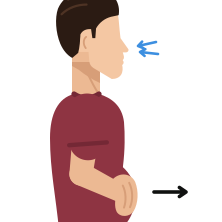 Belly breathingHand on your belly. Breathe in: it rises. Breathe out: it falls.
-
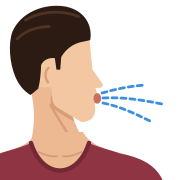 Slow exhaleIn for 4, out slowly for 8. Let your shoulders drop.
-
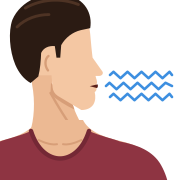 Hiss to buzzOne easy breath on a steady “sss”, the next on a steady “zzz”.
Common mistakes: pushing the belly out on purpose (let it move; don’t shove it), taking huge breaths (low and easy beats big), holding your breath before you speak, and clenching your stomach so hard that your throat clenches too.
Breathing exercises for your voice
Once the basic pattern feels natural, these exercises train it for speech. The breath support routine in DEEP VOICE puts them on a timer.
Breath support
6 minBreathe low so your voice has something to stand on.
- Posture reset50 s
- Belly breathing60 s
- Hiss to buzz60 s
- Breath pulses60 s
- Slow exhale60 s
- Phrase by phrase60 s
- Posture reset gives your breath room: crown up, shoulders down, chin level.
- Belly breathing builds the low in-breath.
- Hiss to buzz trains an even out-breath, first without voice, then with it. It comes from NHS breathing-for-voice leaflets.
- Breath pulses (“ha · ha · HA” from the belly) are inspired by the Accent Method, a voice therapy approach built on belly-led breathing and rhythmic pulses of voice (North Cumbria; ASHA).
- Slow exhale (in for four, out for eight) calms you down and stretches your breath.
- Phrase by phrase carries it into sentences, one phrase per breath.
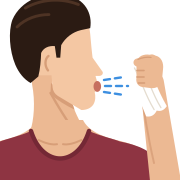
Tissue flow is a good extra. Keeping a tissue fluttering, then adding a soft “ooo”, shows you whether your voice is riding on the air or being squeezed out. Rest if you feel dizzy at any point.
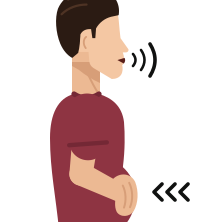

Breathing exercises for voice projection
Being heard across a room is mostly a breathing job. A louder voice needs more air pressure under the vocal folds. If that pressure comes from the belly and ribs, the throat can stay loose. If it doesn’t, the throat squeezes, the pitch climbs and the voice tires. NHS leaflets train this with sounds that swell and fade: a hiss or a buzz that goes quiet, louder, quiet again, using the breath instead of straining the throat (Royal Berkshire).
- On one comfortable note, hum or sing “ooo” and let it grow from soft to medium, then back to soft, all on one breath and on the same pitch. Never past a comfortable medium.
- Count from one to ten to the far wall of the room, as if someone there needs to hear every number. Strong, not loud. Feel your belly working, not your neck.
- If it scratches, you’re pushing. Get quieter and start again.
-
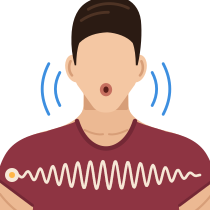 Swell and fadeOne easy note: soft, a little louder, soft again. Same pitch.
-
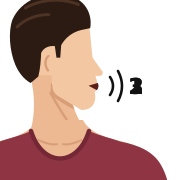 Project your voiceCount 1 to 10 to the far wall. Strong, not loud.
For the full method, including meetings and classrooms, see voice projection exercises.
Carrying it into real conversation
Breathing well on the floor and breathing well in a tense meeting are two different skills. These habits close the gap:
- Breathe before the first word. Let a small, quiet breath drop low, then start speaking as the air begins to flow out. It takes half a second. Nobody notices the pause; everybody hears the first word.
- One thought per breath. Finish the thought, stop, breathe, go on. It slows you down too, which makes your voice sound calmer (see how to speak slower).
- Use the full stops. Every full stop is a free top-up. Take it instead of rushing on.
- Stand up for important calls. Feet planted, shoulders down. Breathing low is easier standing than slumped in a chair.
- Reset under stress. When your heart rate goes up, your breath tends to climb into your chest. One slow exhale before you answer brings it back down.
Expect it to slip when you’re nervous at first. That’s normal, and it gets better with repetition, which is what daily missions are for. For more on nerves, see how to sound more confident.
Week 2 of the challenge: breathe low
In DEEP VOICE, breathing gets its own week straight after you record your baseline, because everything else builds on it. Week 2 goes like this:
- Day 8, belly breathing: three five-minute rounds, morning, midday and evening.
- Day 9, the long exhale: five steady “sss” breaths, timed, then a long sentence on one breath.
- Day 10, checkpoint: record the Day 1 text again, a low breath before each sentence, and compare.
- Day 11, breathe, then speak: a low breath before you start talking, at least ten times in real conversations.
- Day 12, a slower voice note: send one instead of a text, with one deliberate pause.
- Day 13, stand tall on the phone: a real call, standing, breathing low.
- Day 14, breath review: when your breath helped this week, and when it didn’t.
Week 3 then builds resonance on top of that breath: see resonance exercises. Browse all 90 missions on the challenge page, or start in the free web app.
Questions people ask
How do I speak from my diaphragm and not my throat?
Breathe in low through your nose so your belly moves and your shoulders stay still, then speak on a steady out-breath with a loose jaw and throat. Practice lying down first, then sitting, then on a hiss, a buzz and counting before you try it in conversation.
Does speaking from your diaphragm make your voice deeper?
It doesn’t change your pitch range. It often makes your voice sound fuller and steadier, because a throat that isn’t squeezing sounds warmer and stays at its easy note. It works best together with resonance practice and a slower pace.
Why do I run out of breath when I talk?
Usually because the breath is shallow and high in the chest, or because you talk in long runs without pausing. Breathe in low before you start, say one thought per breath and use the full stops to top up.
What are the best breathing exercises for voice projection?
Belly breathing, a steady hiss into a buzz, sounds that swell from soft to medium and back, and counting to the far wall of a room. Together they teach you to get louder with breath, not throat effort.
How long does it take to learn diaphragmatic breathing?
The pattern often clicks within a few sessions, especially lying down. Making it your automatic way of breathing while you talk takes weeks of short daily practice. Cleveland Clinic suggests starting with five to ten minutes, three to four times a day.
Your voice, safely
- Stay in your comfortable range. Never push your voice below what feels easy.
- No pressing on your throat or voice box, and no vocal fry or creak as a technique.
- Stop if it hurts or feels hoarse, scratchy or tired. Drink water and rest your voice.
- Hoarse for more than four weeks (sooner if you smoke), pain when you speak or trouble breathing? See an ENT doctor or a speech-language therapist.
These exercises are voice practice, not medical treatment. More on voice safety.
Sources
- Diaphragm, Cleveland Clinic
- Diaphragmatic Breathing, Cleveland Clinic
- Abdominal breathing, Royal Berkshire NHS Foundation Trust
- Practice Portal: Voice Disorders, American Speech-Language-Hearing Association (ASHA)
- Speech and Language: Accent Method, North Cumbria Integrated Care NHS Foundation Trust