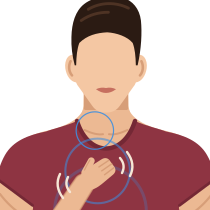
This voice projection exercise has you count from one to ten to a listener across the room, so that every number would reach them. The power comes from a low breath and an open mouth, not from squeezing your throat. It teaches the difference between projecting, which carries, and shouting, which strains: strong, not loud.
How to do project your voice
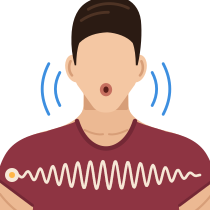
- Pick a targetChoose a point across the room, or imagine a person sitting by the far wall. Stand tall with your feet planted and look at it.
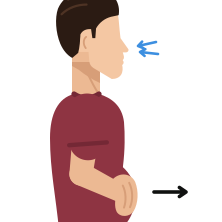
- Breathe in lowTake an easy breath through your nose and feel your belly and lower ribs widen. Keep your shoulders down.
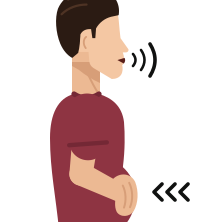
- Count to your listenerSay “one” to the target on a comfortable note, as if handing it to them, then “two”, “three”, up to ten. Give each number a little breath behind it.
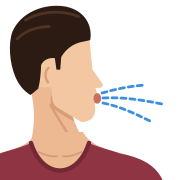
- Open your mouth moreGive each number a clear, open mouth shape and crisp consonants. Clarity carries further than volume.
- Check your throatIf anything scratches or tightens, you are pushing. Drop back to a medium level and use more breath and less squeeze.
- Move the targetCount once to a point near you, then to the middle of the room, then to the far wall. Let the distance change your voice, not extra effort.
Your cue: Count 1 to 10 to the far wall. Strong, not loud.
What it should feel like
You should feel the effort low in your body, around your belly and lower ribs, while your throat stays open and relaxed. The sound should feel as if it travels outward to your target rather than getting stuck in your neck. Afterwards your voice should feel the same as before or better, never scratchy or tired. A strong, well-supported count often feels surprisingly calm.
Why it helps
Shouting and projecting are not the same thing. NHS voice leaflets advise against shouting because raising your voice that way puts more strain on the vocal folds, and suggest a microphone for large groups or long distances (Royal Berkshire NHS). Projection carries the voice with breath support and resonance instead. Deeper, relaxed breathing gives the voice more support for volume and stamina with less strain on the voice box (North Cumbria NHS), and better resonance helps you get louder without forcing (Cambridge University Hospitals NHS).
An open mouth helps too. In an MRI study of trained singers, lip and jaw opening increased as they got louder (Echternach et al., 2016), which is why the steps ask for clear mouth shapes rather than more push. Aiming at one specific listener also gives your voice a reason to carry, which tends to feel more natural than simply turning up the volume.
There is little direct research on this drill itself; it is a practical way to put breath support and resonance to work. If you use your voice all day as a teacher, coach or manager, projection is a skill to build, not a replacement for a microphone. It is trained in Day 38, “The far wall”, and in the voice projection exercises guide.
Common mistakes
- Shouting the numbersIf it sounds like yelling, it is. Bring the level down and let breath and clear consonants carry the count.
- Breathing high in the chestLifting your shoulders to breathe leaves you with no support. Breathe low so your belly and lower ribs move.
- Lifting the chinReaching your chin toward the far wall stretches and tightens the throat. Keep your head level and aim with your eyes.
- Pushing the pitch upA louder voice often climbs in pitch. Keep the numbers on a comfortable speaking note.
Make it easier or harder
Easier
Count to a closer target a few steps away, at a comfortable conversational level, and focus only on breathing low before each number.
A step further
Read a short paragraph to the far wall with the same supported voice, or practice in a bigger space or outdoors, always staying below a shout.
Safety: Projection should never hurt: if your throat scratches, tightens or feels tired, stop and rest your voice. On long days of speaking to groups, use a microphone when you can.
Where it fits
In the DEEP VOICE app, project your voice is part of 2 ready-made warm-ups:
- Before a presentation (8 min): For a talk, a pitch or a toast: grounded, warm and clear.
- Full voice workout (9 min): Breath, release, resonance and projection. The complete set.
Read more in Speak from your diaphragm, Vocal warm-up for speaking and Voice projection exercises.
Questions people ask
How do I project my voice without yelling?
Breathe low, open your mouth more, speak clearly and aim your words at a specific listener. Let the breath do the work and keep your throat relaxed. If it starts to scratch, you are pushing: back off and use more breath and less squeeze.
What are good voice projection exercises for beginners?
Start with belly breathing to feel a low breath, then this counting drill to a near target and then a far one. Humming and swell-and-fade exercises build resonance and controlled volume. A few minutes daily works better than one long session.
How can teachers project without losing their voice?
Rely on breath support and resonance instead of volume, face the class, wait for quiet rather than talking over noise, and use a microphone in large rooms. Drink water through the day. If you are hoarse for more than four weeks, see an ENT doctor or a speech-language therapist.
Why does my throat hurt when I project?
Usually because the effort is in your throat instead of your breath, or you are shouting rather than projecting. Rest your voice, then practice at a lower level with low breathing and an open mouth. Pain or hoarseness that persists needs a check from a doctor or a speech-language therapist.
Sources
- Voice care tips for a healthy voice, Royal Berkshire NHS Foundation Trust
- Speech and language: diaphragmatic breathing, North Cumbria Integrated Care NHS Foundation Trust
- Humming exercises, Cambridge University Hospitals NHS Foundation Trust
- Morphometric differences of vocal tract articulators in different loudness conditions in singing (Echternach et al., 2016), PLoS One
Your voice, safely
- Stay in your comfortable range. Never push your voice below what feels easy.
- No pressing on your throat or voice box, and no vocal fry or creak as a technique.
- Stop if it hurts or feels hoarse, scratchy or tired. Drink water and rest your voice.
- Hoarse for more than four weeks (sooner if you smoke), pain when you speak or trouble breathing? See an ENT doctor or a speech-language therapist.
These exercises are voice practice, not medical treatment. More on voice safety.