The short answer
Voice projection is being heard clearly at a distance without forcing your throat. It comes from four things working together: a low breath that powers the sound, resonance that makes it ring, crisp consonants that carry the words, and an upright posture that gives your breath room. Practice with breath pulses, humming, swell and fade and counting to a far wall, moving further away as it gets easy. If your throat scratches, you’re pushing.
What voice projection is, and what it isn’t
When people try to be louder, most of them squeeze. The throat tightens, the pitch jumps up, the neck and shoulders lift, and the voice gets harsher rather than bigger. It works for a sentence or two, then the voice tires, cracks or goes hoarse by the end of the day. That’s yelling.
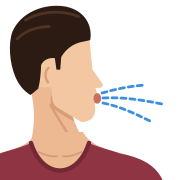
Projection is different. The extra energy comes from your breath, the sound rings in your mouth and chest instead of being pressed out of your throat, and your words are clear enough that people at the back catch every one. A projected voice is often not much louder than a strained one. It’s clearer, steadier and far less tiring to make.
Voice clinicians treat shouting and talking over noise as habits to reduce, not skills to build, and NHS voice-care advice says plainly that raising your voice puts more strain on your vocal folds. So every exercise below has the same goal: more carry, less squeeze. As Day 38 of the challenge puts it, projection is aim, not volume.
The four parts of a voice that carries
- Breath. A low, unhurried breath in, then a steady flow out, gives the voice something to stand on. You feel it as a gentle firming around your belly and lower ribs while you speak, not a push in your throat. How to speak from your diaphragm covers this in depth.
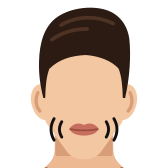
- Resonance. The buzz you feel on your lips, nose and chest when you hum is sound being amplified by the spaces it travels through. A voice with that buzz carries further for the same effort. See resonance exercises.
- Articulation. At a distance, vowels survive and consonants get lost. Crisp “t”, “k”, “p” and “d”, and words finished rather than swallowed, make you sound louder than you are.
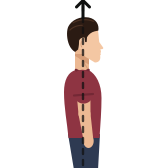
- Posture. Standing or sitting tall, chin level and shoulders down, frees your ribs and belly to move. Slumping over a desk, or craning your neck toward the back row, squeezes the breath.
Voice projection exercises for beginners
A seven-minute session, in this order. Do it standing, with water nearby, and keep every sound in your comfortable range.
- Posture reset (30 seconds). Imagine a string lifting the crown of your head, and let your shoulders slide down.
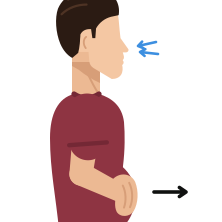
- Belly breathing (1 minute). One hand on your belly, one on your chest. Breathe in through your nose so the belly moves out while the chest stays almost still.
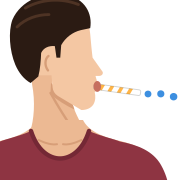
- Breath pulses (1 minute). Hand on your belly, pulse “ha · ha · HA” with a small inward bounce of the belly on each beat, the last one a little stronger. This is what it feels like when breath does the work. Rest if you feel dizzy.
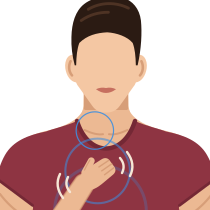
- Hum into vowels (1 minute). Hum until you feel the buzz on your lips, then open into “mmm-ah” and “mmm-oh” without losing it.
- Swell and fade (1 minute). On one comfortable note, let an “ooo” grow from soft to medium and back to soft on one breath. The breath does the growing and the pitch stays put. Stop at a comfortable medium, never a shout.
- Project your voice (1 minute). Pick a spot on the far wall and count from 1 to 10 so that every number would reach it.
- Clear speech (1 minute). Read a few sentences to the same spot with crisp consonants and every word finished, natural rather than robotic.
It should feel like effort in your belly and ease in your throat. A slight rise in pitch as you get louder is normal. A squeezed jump, a scratch, or a tickle that makes you want to cough means you’re pushing: go back a step. The soft-to-medium swell is a classic singing exercise, and an NHS breathing-for-voice leaflet uses the same idea, with sounds that grow from quiet to loud and back.
-
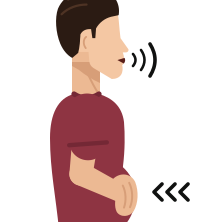 Breath pulsesHand on your belly. Pulse “ha · ha · HA” from the belly, slow and easy.
-
 Hum into vowelsHum “mmm”, then open into “ah”. Keep the buzz as you open.
-
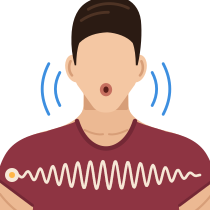 Swell and fadeOne easy note: soft, a little louder, soft again. Same pitch.
-
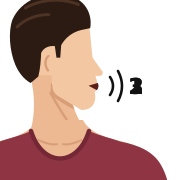 Project your voiceCount 1 to 10 to the far wall. Strong, not loud.
-
 Clear speechCrisp consonants, every word finished, no rush. Clear, not robotic.
A progressive-distance drill
Projection is really a skill of judging distance, so train it at distances. You need a long room, a hallway, a yard or a park, and ideally a friend, or your phone recording from the far end.
- Arm’s length. Say a sentence at your normal conversational volume, for example “Good morning, everyone, let’s get started.” Notice how little effort it takes. That ease is what you’re keeping.
- Across a table, about 2 meters (6 feet). Breathe in low, count from 1 to 5 to your target, then say the sentence. Open your mouth a little more and sharpen the consonants.
- Across a room, about 5 meters (15 feet). Same again, with a slightly fuller breath. Aim the words at your listener’s face, not the floor between you.
- The far wall, about 10 meters (30 feet). Same again, a little slower: fast speech blurs over distance. Pause at the end of the sentence and let it land.
- Back to arm’s length. Finish where you started, at an easy conversational volume.
At each stage, ask your listener whether they caught every word, or play back the recording. If your throat tightens or scratches, go back one stage and take two easy breaths before trying again. Move on only when a stage feels easy. Most people need a few sessions before the far wall feels as relaxed as the table.
Projection for teachers and people who talk all day
Teachers are a known high-risk group. The American Speech-Language-Hearing Association (ASHA) cites estimates that teachers are two to three times more likely than the general population to develop a voice disorder, with more classes per week, outside noise and loud lecturing all adding to the risk. Coaches, fitness instructors, tour guides and call-center staff face a smaller version of the same problem. Good technique helps, but the biggest wins come from needing your voice less:
- Amplify. Use a microphone or a small wearable amplifier for large groups and big rooms. ASHA notes that amplification can help prevent the strain of talking at increased volume, and NHS advice for teachers recommends it for large groups or listeners far away.
- Signal instead of speaking. A bell, a clap pattern, lights off, a raised hand, or a whistle outdoors gets attention without raising your voice. Put repeated reminders on the board or in a picture.
- Don’t talk over noise. Wait for quiet, or bring the group close before you give instructions. Turn off noisy equipment where you can.
- Build in voice rest. Short breaks between lessons, and lessons that switch between your talking and pair work, group work or reading. Handouts and written instructions save repeating yourself.
- Hydrate. Water through the day, less caffeine, and a humidifier in a dry, heated room.
- Talk quietly rather than whisper when your voice is tired. Whispering is tiring and drying too.
- Warm up before a heavy day. ASHA suggests gentle humming. The vocal warm-up for speaking guide has a five-minute routine.
Hoarse for more than four weeks (sooner if you smoke), pain when you speak, or a voice that gives out every afternoon? See an ENT doctor or a speech-language therapist. Getting checked early beats pushing through a whole term.
Projection for drama and the stage
On stage, the same four parts apply, plus a few habits actors learn early:
- Play to the back row. Before rehearsal, stand on the stage and say a line to the last seat. Your body adjusts breath and articulation to a target it can see.
- Keep your face open to the audience. Turning away or dropping your chin to the floor costs volume and clarity, and consonants go first.
- Put emotion in the breath and the body, not the throat. Anger, panic and grief tempt actors to squeeze. A big emotional line needs more breath and clearer words, not a tighter neck.
- Treat a scripted shout as choreography. Mark it at a lower volume in rehearsal, and ask your director or a voice coach how to play it safely night after night.
- Warm up before every rehearsal and show, and run the progressive-distance drill in the actual space.
How to speak louder without straining: quick fixes
For the moment someone says “Can you speak up?”:
- Sit or stand taller and turn to face your listeners.
- Take a slightly fuller, low breath before the sentence, not halfway through it.
- Open your mouth a little more and finish your consonants.
- Slow down a touch, and pause at full stops.
- Move closer, cut the background noise, or use the microphone.
- On a video call, speak at your normal volume and let the microphone do the work. Headphones stop you raising your voice to hear yourself.
Signs you’re straining: a tight or scratchy throat, a voice that cracks or goes breathy, a tight neck or lifted shoulders, and hoarseness afterward. When you notice them, stop, sip water and rest your voice. A steady, unhurried pace carries further than a fast one, so how to speak slower is worth reading too.
Take it into real rooms: Week 6 of the challenge
Exercises teach the feeling; real rooms make it automatic. Week 6 of the challenge, “Carry the room”, takes projection out of the practice corner:
- Day 38, The far wall: count to ten to a point about 10 meters away, then read a paragraph to it.
- Day 39, The noisy room: hold a conversation in a café or on a busy street without shouting.
- Day 40: record the same text as on Day 1 and compare.
- Day 41, Speak first: open a meeting, class or group conversation with a low breath and a full voice.
- Day 42, Steady to the last word: read aloud for five minutes, keeping your volume steady to the end of every sentence.
- Day 43, Make a toast: 30 to 60 seconds to a group.
- Day 44: write down where your voice carried, where you pushed, and how your throat felt.
Week 6 is in the 60- and 90-day challenges. In the first 30 days, Week 2 (breathe low) and Week 3 (find your resonance) build the foundations. Start free in the web app.
Questions people ask
How do I project my voice without yelling?
Power the sound with a low breath, keep your throat and jaw relaxed, and make your consonants crisp so the words carry. Aim at a point at the back of the room and slow down slightly. If your throat tightens or scratches, you’ve tipped into yelling: back off and use more breath, less squeeze.
What are good voice projection exercises for teachers?
Breath pulses, humming into vowels, swell and fade, and counting to the far wall make a good core set. Just as important are signals that save your voice, a microphone for large groups, short voice breaks and plenty of water, because teachers are at higher risk of voice problems than most people.
How can I speak louder without straining my voice?
Stand tall, take a fuller low breath before you start, open your mouth a little more and finish every word. Slow down and pause, move closer or reduce the noise, and use a microphone when you can. Strain feels like tightness or scratchiness in the throat, so stop and rest if you notice it.
Can I learn to project if I have a naturally quiet voice?
Usually, yes. Many quiet speakers aren’t short of power; they just don’t use their breath and resonance fully yet. Practice the progressive-distance drill a few times a week. If your voice stays weak, breathy or tired despite practice, have it checked by an ENT doctor or a speech-language therapist.
Why does my throat hurt when I try to speak louder?
Usually because your throat is doing the work your breath should do, squeezing to make volume. Stop, rest your voice and drink some water. Pain when you speak is a reason to see an ENT doctor or a speech-language therapist, especially if it keeps happening.
Your voice, safely
- Stay in your comfortable range. Never push your voice below what feels easy.
- No pressing on your throat or voice box, and no vocal fry or creak as a technique.
- Stop if it hurts or feels hoarse, scratchy or tired. Drink water and rest your voice.
- Hoarse for more than four weeks (sooner if you smoke), pain when you speak or trouble breathing? See an ENT doctor or a speech-language therapist.
These exercises are voice practice, not medical treatment. More on voice safety.
Sources
- Voice disorders (Practice Portal), American Speech-Language-Hearing Association (ASHA)
- Protect your voice this back-to-school season, American Speech-Language-Hearing Association (ASHA)
- Voice care advice for teachers, Cambridge University Hospitals NHS Foundation Trust
- Voice care tips for a healthy voice, Royal Berkshire NHS Foundation Trust
- Abdominal breathing, Royal Berkshire NHS Foundation Trust