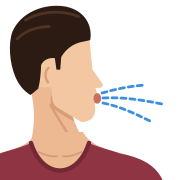
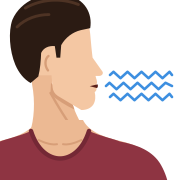
Belly breathing is diaphragmatic breathing in plain words: you breathe in so your belly and lower ribs move out while your chest and shoulders stay almost still, then you let the air go gently. The diaphragm, a dome-shaped muscle under your lungs, does the work. Voice therapists teach it because low, relaxed breaths give your voice steady air without tension in your neck and throat.
How to do belly breathing
- Get comfortableSit upright with both feet flat on the floor, or lie on your back with your knees bent. Lying down is the easiest way to learn it.
- Place your handsRest one hand on your belly, just above your belly button, and the other flat on your upper chest.
- Breathe in through your noseBreathe in slowly and quietly through your nose and let your belly push your lower hand out. Your upper hand and your shoulders stay almost still.
- Let the air goBreathe out gently through your mouth and feel your belly sink back in. Don’t push the air out; let it fall.
- Pause, then repeatWait a moment until the next breath wants to come, then repeat. Six to eight slow breaths make one round.
- Add a quiet soundWhen it feels natural, breathe out on a soft “sss” or count quietly to five, keeping the same belly movement. This is the bridge to using it when you speak.
Your cue: Hand on your belly. Breathe in: it rises. Breathe out: it falls.
What it should feel like
Quiet and slow. Your lower hand rises and falls while your upper hand barely moves, and your shoulders stay away from your ears. The movement is small, not a balloon: some people feel it more at the sides of the waist or in the lower back than at the front. The in-breath is silent. A gasp, a sniff or a shoulder lift means you’re pulling too hard, so slow it down.
Why it helps
Your voice runs on air from your lungs. When you breathe high, with the chest and shoulders, the muscles around your neck join in and the air runs out quickly, which tends to tighten the throat and leave you squeezing out the end of sentences. NHS speech and language therapists teach abdominal breathing to give the voice enough steady air without strain (Royal Berkshire NHS) and to cut down tension in the shoulders and upper chest (North Cumbria NHS).
Here’s what the diaphragm does. When you breathe in, it contracts and moves down, drawing air into your lungs and nudging your belly outward. When you breathe out, it relaxes and the belly comes back in (Cleveland Clinic). You can’t feel the muscle itself, which is why the hand on your belly is the cue. “Speaking from your diaphragm” really means letting this low breath carry your voice so your throat doesn’t have to push. Our guide to speaking from your diaphragm shows how to carry it into real sentences, and Week 2 of the challenge, Breathe low, builds it into daily missions.
Belly breathing is a standard starting point in voice therapy and in singing lessons, and it’s also used for relaxation. It won’t change your pitch. What it can change is how steady and full your voice sounds: enough air to finish a sentence without squeezing, and a calmer body to speak from. For singing, the same low breath is the foundation a voice teacher builds on.
Common mistakes
- Lifting the shouldersIf your shoulders rise, the breath is going high. Let them drop and slow the in-breath down.
- Pushing the belly outShoving the stomach forward without breathing in doesn’t help. Let the air arrive and the belly follow.
- Taking huge breathsBig, fast breaths can make you lightheaded. A normal-sized breath, just lower, is enough.
- Holding the stomach inA habit of sucking in your stomach or a tight belt blocks low breathing. Loosen up and let the belly move.
Make it easier or harder
Easier
Lie on your back with your knees bent and rest a light book on your belly. Watch it rise as you breathe in and sink as you breathe out.
A step further
Stand and read a paragraph aloud, taking a quiet belly breath at the end of every sentence. Keep a hand on your belly to check the breath stays low while you talk.
Safety: If you feel lightheaded or start yawning a lot, you’re breathing too much or too fast: go back to normal breathing and slow down. Keep each practice short, a few minutes at most.
Where it fits
In the DEEP VOICE app, belly breathing is part of 3 ready-made warm-ups:
- Pre-mission warm-up (5½ min): 5½ minutes of breath, release and resonance before today's mission.
- Breath support (6 min): Breathe low so your voice has something to stand on.
- Full voice workout (9 min): Breath, release, resonance and projection. The complete set.
Read more in Deep voice exercises, Speak from your diaphragm, Voice projection exercises and How to speak slower.
Questions people ask
How do I breathe from my diaphragm when speaking?
Learn the belly breath lying down or sitting first, then take one before you start a sentence and let the words ride out on the out-breath. Pause at commas and periods to top up, low and quiet, instead of gasping. A hand on your belly while you practice keeps you honest.
Is belly breathing the same as diaphragmatic breathing?
For practical purposes, yes. The diaphragm is the muscle doing the work, and the belly moving out is the visible sign that it is. Abdominal breathing is a third name for the same thing.
Is diaphragmatic breathing good for singing?
Yes, it’s the usual foundation in singing lessons: a low, relaxed breath that doesn’t lift the shoulders. Singers then learn to control how the air is released, which a voice teacher can guide.
Will breathing from my diaphragm make my voice deeper?
It won’t change your natural pitch. It can make your voice sound fuller and steadier, because you stop running out of air and squeezing at the end of sentences, which is often what makes a voice sound tight and high.
Sources
- Abdominal breathing, Royal Berkshire NHS Foundation Trust, Speech and Language Therapy
- Speech and language: diaphragmatic breathing, North Cumbria Integrated Care NHS Foundation Trust
- Diaphragmatic breathing, Cleveland Clinic
Your voice, safely
- Stay in your comfortable range. Never push your voice below what feels easy.
- No pressing on your throat or voice box, and no vocal fry or creak as a technique.
- Stop if it hurts or feels hoarse, scratchy or tired. Drink water and rest your voice.
- Hoarse for more than four weeks (sooner if you smoke), pain when you speak or trouble breathing? See an ENT doctor or a speech-language therapist.
These exercises are voice practice, not medical treatment. More on voice safety.