The slow exhale is a breathing exercise in which you breathe in low for four counts and let the air out through softly pursed lips for about eight. The longer out-breath slows your breathing and settles you. It also trains the steady, controlled release of air that your voice rides on when you speak a full sentence without rushing or running out.
How to do slow exhale
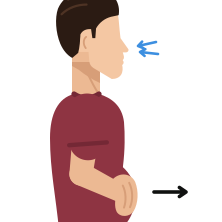
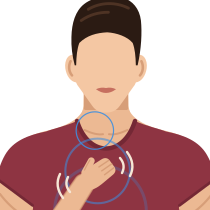
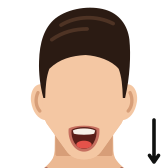
- Drop your shouldersSit or stand tall and let your shoulders drop. Rest one hand on your belly.
- Breathe in low for fourBreathe in quietly through your nose for a count of four, letting your belly move out.
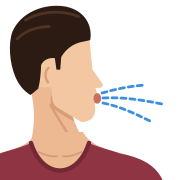
- Purse your lipsShape your lips as if you were about to cool a spoonful of soup: soft, slightly rounded, a small opening.
- Breathe out for eightLet the air out slowly and evenly through your lips for about eight counts. The flow at count seven should feel the same as at count two.
- Rest and repeatLet the next breath come in through your nose on its own, then repeat. Five or six rounds take about a minute.
Your cue: In for 4, out slowly for 8. Let your shoulders drop.
What it should feel like
A thin, even stream of air that you could feel on the back of your hand, like a slow leak from a tire. Your belly sinks in gradually as you breathe out, and your shoulders stay heavy. The last counts should still feel easy; if you’re squeezing to reach eight, you let too much out at the start. After a minute most people notice their shoulders lower and their breathing calmer.
Why it helps
Making the out-breath longer than the in-breath is a well-used way to slow your breathing down. Cleveland Clinic’s guide to pursed-lip breathing uses the same shape: in through the nose, then out gently through pursed lips for longer than you breathed in, without forcing the air out. In a Stanford trial comparing daily breathing practices, the exhale-focused pattern showed the strongest effects on mood and breathing rate (Balban et al., 2023).
For your voice, the out-breath is where speech happens. NHS speech and language therapists build breath control by gradually lengthening the out-breath, from four counts up toward ten, with a firm rule never to strain at the end of a breath (Royal Berkshire NHS). People who sound rushed or breathless often snatch a quick, high breath and spend most of it on the first few words. Practicing a slow, even release teaches you to pace the air so the last word of a sentence sounds as full as the first.
This is breathing practice, not a test of how long you can last, and it won’t change your pitch. What it builds is a calmer, steadier sound. Once the long exhale feels easy, carry it into speech with phrase by phrase or the slow count, and read how to speak slower for everyday situations.
Common mistakes
- Blowing hard at the startIf most of the air rushes out in the first two counts, you’ll be empty by five. Start with a thin, slow stream.
- Squeezing to reach eightEight is a target, not a rule. Six comfortable counts are better than eight squeezed ones.
- Pressing the lips togetherHard-pressed lips make you push. Keep them soft, just enough to slow the air.
- Gulping the next breathAfter a long exhale it’s tempting to gasp. Let the in-breath come quietly through your nose.
Make it easier or harder
Easier
Start with in for three and out for five, and add one count to the out-breath every few rounds as it gets easy.
A step further
Breathe out on a soft, steady “sss” or “fff” instead of plain air, then on a quiet counted “one, two, three…” riding the same even flow.
Safety: If you feel lightheaded or dizzy, stop and breathe normally for a minute. Never hold on or force out the last bit of air.
Where it fits
In the DEEP VOICE app, slow exhale is part of 4 ready-made warm-ups:
- Before a call (6½ min): A warm, steady voice for the phone or a video call.
- Calm voice (6½ min): Slow your breath and soften a tight throat before something tense.
- Breath support (6 min): Breathe low so your voice has something to stand on.
- One-minute reset (1 min): Voice tight or rushing? Sixty seconds back to low and slow.
Read more in Deep voice exercises, Speak from your diaphragm, Vocal warm-up for speaking and How to speak slower.
Questions people ask
Why is a long exhale calming?
Lengthening the out-breath slows your overall breathing rate, and slow breathing goes with a calmer state. It also gives your attention something simple to follow. Research on breathing practices is still young, but an exhale-focused pattern did well for mood in at least one randomized trial.
How do I stop running out of breath when I talk?
Breathe in low before you start, let the air out slowly instead of in a rush, and pause at commas and periods to top up. The slow exhale trains the release; phrase-by-phrase practice trains the pauses.
Is this the same as pursed-lip breathing?
It uses the same technique: in through the nose, out for longer through softly pursed lips. Pursed-lip breathing is also taught for some lung conditions. Here it’s used to steady your breath before you speak.
How often should I do it?
A minute before you speak, plus a few rounds whenever you notice your breathing has gone fast and high. Little and often works better than one long session.
Sources
- Pursed-lip breathing, Cleveland Clinic
- Abdominal breathing, Royal Berkshire NHS Foundation Trust, Speech and Language Therapy
- Brief structured respiration practices enhance mood and reduce physiological arousal (Balban et al., Cell Reports Medicine, 2023), Huberman Lab, Stanford University School of Medicine
Your voice, safely
- Stay in your comfortable range. Never push your voice below what feels easy.
- No pressing on your throat or voice box, and no vocal fry or creak as a technique.
- Stop if it hurts or feels hoarse, scratchy or tired. Drink water and rest your voice.
- Hoarse for more than four weeks (sooner if you smoke), pain when you speak or trouble breathing? See an ENT doctor or a speech-language therapist.
These exercises are voice practice, not medical treatment. More on voice safety.