The short answer
To speak slower, don’t stretch every word: pause more. Stop at each full stop, take a small low breath, and say one thought per breath. Finish your consonants, so clarity sets the pace. Measure yourself by recording a one-minute reading and counting the words; for talks, many speaking coaches suggest roughly 120 to 160 words per minute. Then practice on real reading and recordings until the pauses feel normal.
Why you talk too fast
Most fast talkers can slow down for a sentence when asked. The speed comes back because something keeps pushing it:
- Nerves. Part of you wants it over with, and finishing sooner feels safer. A speaking coach writing in Toastmasters’ magazine names nerves as a main reason people rush. Adrenaline speeds everything up, including your sense of time.
- A shallow, high breath. If you breathe into your upper chest and start on half a breath, you run short mid-sentence, hurry to reach the end, gulp, and repeat. Rushing is partly a breathing problem.
- Fear of silence or interruption. If you’ve often been talked over, you may have learned to leave no gaps. Every pause feels like an invitation to be cut off.
- Too much to say. Ten minutes of material for a five-minute slot means speeding up. So does trying to fit everything into one answer.
- Habit, family and culture. Some people and some places simply talk fast, and that works fine in its own setting.
One more thing: from the inside, your own pace always sounds normal. That’s why measuring and recording, below, matter so much.
What is a normal speaking rate?
There’s no single right speed. In a large study of recorded American English phone conversations, the average across whole conversations, pauses included, was about 196 words per minute, and individual conversations ranged from about 111 to 291. Older speakers tended to be slower, and men slightly faster than women. Everyday conversation can be quick and still easy to follow, because the listener can always ask you to repeat.
A talk or presentation is different: nobody can stop you to ask. Toastmasters’ magazine suggests about 120 to 160 words per minute as an effective rate for speaking to an audience. Treat that as a coaching rule of thumb rather than a scientific norm. Pauses, clear words and how familiar the topic is to your listeners matter as much as the raw number.
How to measure your rate:
- Pick a page of plain prose, such as a news article, and record yourself reading it aloud for exactly one minute.
- Count the words you got through. That’s your reading rate.
- Now record yourself speaking without a script for one minute: explain your job, or what you did yesterday. Count the words by hand or with your phone’s transcription. That’s your speaking rate.
- Listen back once for speed, and once only for pauses: where did you stop to breathe, and where did sentences run together?
If you’re well above 160 in a talk, slow down. If your number looks reasonable but people still find you hard to follow, the problem is usually missing pauses and swallowed word endings, not the word count.
Pause at full stops and breathe in phrases
The main technique is simpler than trying to say every word slowly: slow down by adding pauses, not by stretching words. Stretched words sound robotic. Pauses sound calm.
- One thought, one breath. Finish a thought, let the last word fall, stop, take a small low breath, then start the next. No “and… so… and…” chains.
- Pause at every full stop. About a second is plenty. Commas get a shorter beat. Before your most important point, wait a little longer.
- Breathe in the pauses, never mid-phrase. Short phrases are easier to breathe for than long ones. Finish each phrase with air to spare instead of squeezing out the last words.
- Mark your notes. For a talk or a reading, draw a slash where you’ll pause and a breath mark before each new point.
The pause will feel long to you. To the listener it sounds like thinking, and it gives them time to take in what you just said. Toastmasters’ advice is the same: take a quiet breath in each pause, and don’t fill it with “ah” or “um”. If breathing low is new to you, how to speak from your diaphragm covers it step by step.

Exercises to speak slower and clearer
Five minutes, once a day. Each one trains a different part of pace.
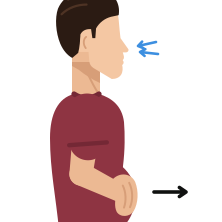
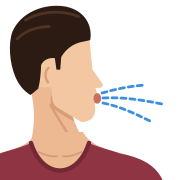
- Box breathing (1 minute). In for 4, hold for 4, out for 4, hold for 4. It settles your breathing before you start, and a settled breath makes a slower start.
- Slow count (1 minute). Count to 10 in pairs: “one, two”, pause and breathe, “three, four”, pause. Let each number land before the next.
- Phrase by phrase (1 minute). Build a sentence one phrase per breath: “I walked.” (breathe) “I walked to the station.” (breathe) “I walked to the station in the rain.”
- Clear speech (1 minute). Talk as if to a friend across a busy café: crisp “t”, “k”, “p” and “d”, every word finished, a natural melody. Clear speech is a speaking style used in voice therapy, and people using it typically slow down, lengthen their pauses and vary their pitch more. Clarity works as a brake you don’t have to think about.
- Chant to speech (1 minute). Chant a sentence on one easy note, smooth and connected, then say it normally with the same flow. The chant slows you down without making you sound slow.



How to speak slower when nervous, presenting or in an interview
When you’re nervous. Plan your first sentence and say it slower than feels natural; the rest of your pace tends to follow the first line. Breathe out before you begin, so your first breath in is low rather than a gasp. If you feel yourself speeding up, get to the next full stop and take a full pause. The confidence guide has a step-by-step reset for nerves that hit mid-sentence.
When presenting:
- Cut content, not pauses. If your talk runs long, drop a point rather than speeding up. Put the most important ideas first, so any cuts come from the end.
- Write the pauses in. Slashes, breath marks, or the word PAUSE in your notes.
- Rehearse out loud with a timer. One coaching trick: if a section takes you 30 seconds, practice delivering it in 40, until the slower version feels normal.
- Build in natural stops. A question to the audience, a slide change, a sip of water.
- Slow down for what matters. Names, numbers and your key point get the slowest pace; transitions can move along.
In an interview. Take one breath before every answer; it doubles as thinking time. Answer in two or three clear points, then stop rather than adding more to fill the silence. If you notice you’re racing, finish the sentence and say “Let me put that more simply.” It buys you a reset and sounds thoughtful.
On calls and video. Lag makes rushing worse, because people start talking over each other. Leave a beat after the other person finishes, and another before you hand back.
Practice on real reading and recordings
Drills teach the feeling; reading aloud turns it into a habit. Five minutes a day is enough:
- Take a page of something you’d actually read: a news article, a book chapter, a work email.
- Mark a slash at every full stop and at the natural phrase breaks.
- Record yourself reading it, pausing and breathing at every slash.
- Listen back for rushed sentence endings, gasped breaths, fillers and swallowed words.
- Read it again a little slower, then put the page down and talk about it for one minute with the same pauses.
Measure your words per minute once a week on the same kind of text, and keep the recordings. Hearing week one next to week four is the clearest proof that you’ve changed. Don’t aim for slow everywhere: varying the pace, quicker through easy material and slower on what matters, keeps you sounding natural rather than dragged out.
When fast speech is something else
For most people, talking fast is a habit that practice changes. Sometimes it’s part of a fluency difference. In cluttering, speech can sound rapid or irregular, with words running together and pauses in unexpected places; ASHA notes that the measured rate isn’t always faster than average, but it is faster than the speaker can comfortably manage. Stuttering involves repetitions, stretched sounds or blocks that interrupt the flow of speech.
If that sounds familiar, or people often can’t follow you even when you try to slow down, a speech-language therapist (SLP) is the right person to see. SLPs assess and treat both stuttering and cluttering, and can tailor techniques to you. The general drills in this guide aren’t a substitute for that.
Make it stick: Week 4 of the challenge
Week 4 of the challenge, “Slow down”, turns the techniques in this guide into a week of real conversations:
- Day 22, One thought, one breath: finish each thought, stop, breathe, then go on.
- Day 23, Falling endings: statements that end down.
- Day 24, Silence on purpose: swap fillers for short pauses.
- Day 25, Speak up in a group with a low breath and a calm pace.
- Day 26, Morning voice: warm up before you speak to anyone.
- Day 27, Tell it slowly: a story with a clear pause right before the key moment.
- Day 28: write down where slowing down worked and where you sped up.
Week 4 is part of the 30-day challenge, alongside a daily habit: speak a little slower than feels natural, and pause. Open the free web app to start.
Questions people ask
How can I speak slower and clearer?
Pause at every full stop and breathe, say one thought per breath, and finish your consonants so each word is complete. Clear articulation slows you down naturally. Practice by reading aloud with the pauses marked, recording yourself and listening back.
How do I stop talking fast when I’m nervous?
Plan your first sentence and say it slower than feels natural, then pause at full stops. Breathe out before you start so your next breath is low rather than a gasp. If you speed up, finish the sentence, pause, and restart with a shorter one.
How many words per minute should I speak when presenting?
Speaking coaches commonly suggest roughly 120 to 160 words per minute for talks, slower than everyday conversation often runs. Treat it as a guide: clear words and pauses in the right places matter more than the exact number.
How do I slow down in an interview?
Take a breath before each answer, give two or three clear points, and stop when you’ve made them. Rehearse the openings of your key answers out loud beforehand. If you notice yourself racing, finish the sentence and pause before going on.
Will speaking slower make me sound boring?
Not if you slow down with pauses rather than by stretching every word. Keep your natural melody, and move faster through easy material and slower on what matters. A well-paced speaker usually comes across as calm and easy to follow.
Your voice, safely
- Stay in your comfortable range. Never push your voice below what feels easy.
- No pressing on your throat or voice box, and no vocal fry or creak as a technique.
- Stop if it hurts or feels hoarse, scratchy or tired. Drink water and rest your voice.
- Hoarse for more than four weeks (sooner if you smoke), pain when you speak or trouble breathing? See an ENT doctor or a speech-language therapist.
These exercises are voice practice, not medical treatment. More on voice safety.
Sources
- Towards an integrated understanding of speaking rate in conversation (Yuan, Liberman and Cieri, 2006), Interspeech 2006, Linguistic Data Consortium
- How to quit talking quickly, Toastmaster magazine, Toastmasters International
- Controlling your pace and pitch, Toastmaster magazine, Toastmasters International
- Efficacy of conversation training therapy (Gillespie et al., 2019), Journal of Speech, Language, and Hearing Research (PMC)
- Stuttering, cluttering, and fluency (Practice Portal), American Speech-Language-Hearing Association (ASHA)
- Abdominal breathing, Royal Berkshire NHS Foundation Trust