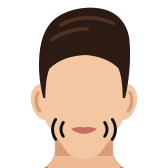
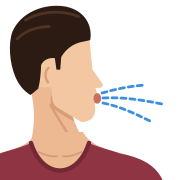
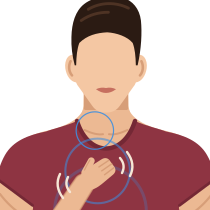
Chant to speech is a simplified version of chant talk, a technique speech-language therapists use to make voicing easier. You chant a short sentence on one comfortable note, smooth and connected, then say it normally while keeping the same ease and buzz. It trains a lighter, more resonant way of speaking and a smoother flow from one word to the next.
How to do chant to speech
- Pick a short sentenceChoose something you actually say, like “Hello, my name is Sam” or “Can I have a coffee, please?”. Sentences with m, n and l sounds are easiest to start with.
- Find an easy noteHum briefly and settle on a note in the middle of your comfortable range, about where “mm-hmm” sits. Not a forced low note, and not a high one.
- Chant it on that noteSay the whole sentence on that one note, smooth and connected, like a gentle chant. Let the words run into each other with no gaps and keep the buzz on your lips.
- Speak it the same wayNow say the sentence normally. Let the natural up-and-down melody come back, but keep the same ease, buzz and smooth connection.
- Alternate chant and speechChant, speak, chant, speak, four to six times. Each time, make the spoken version feel a little more like the chant.
- Change the sentenceMove to a new sentence once the first feels easy. Finish with one you’ll actually say later today.
Your cue: Chant a sentence on one easy note, then say it with the same buzz.
What it should feel like
The chant feels like humming with words in it: steady, smooth and easy, with a light buzz on the lips and no catch between words. When you switch to speaking, the sentence feels lighter than usual, as if it glides out in one piece instead of being pushed out word by word. It may sound a touch sing-song at first. That’s fine; it settles with practice.
Why it helps
ASHA lists chant speech among voice-therapy techniques: a rhythmic, chant-like pattern used as a template for speaking, to reduce effort and vocal fatigue. A chant has no hard starts, no sudden jumps and no gaps, so the voice gets a long, steady run, and speaking straight afterwards lets you borrow that ease. A Dorset County Hospital NHS leaflet uses chanting the same way: gently chant syllables and words starting with m on a clear note, then short phrases.
Therapists often use chanting as a bridge from exercises to conversation. In a 2023 voice-therapy handout by speech-language pathologists at Henry Ford Health, patients chant words, phrases and sentences in a resonant way, then switch to saying the same sentences conversationally. That chant-then-speak step is what this exercise keeps. The full method is taught and adjusted by a speech-language therapist; this is a simplified version for practice alone.
One thing to know if you want a deeper voice: this isn’t the exercise for it. In a pilot study in which healthy female speech-language therapy students practiced chant talk for 18 weeks, their voices became less breathy, and average pitch went up, not down, compared with a control group. Use it for ease, resonance and a smoother flow. For pace, pair it with phrase by phrase.
Common mistakes
- Chanting on a forced low noteA pushed-down note strains the throat and loses the buzz. Choose a note in the middle of your comfortable range.
- Choppy, robotic chantingA chant is smooth, not a march. Join the words so the sound never stops between them.
- Losing the ease when speakingIf the spoken version snaps back to your usual push, chant again and try a softer, slower spoken version.
- Chanting too loudlyVolume adds effort. Chant at a quiet, conversational level.
Make it easier or harder
Easier
Chant single words first, like “many”, “morning” and “mellow”, then two-word phrases, before full sentences.
A step further
Chant a short paragraph line by line, then read it aloud normally. Or chant the first line of a call or meeting, then say it for real.
Safety: Stay on a note that feels easy, and stop if your throat tightens, scratches or feels tired.
Where it fits
In the DEEP VOICE app, chant to speech is part of 2 ready-made warm-ups:
- Before a call (6½ min): A warm, steady voice for the phone or a video call.
- Resonance builder (7½ min): Find the buzz and move your voice out of your throat.
Read more in Deep voice exercises, Resonance exercises for your voice, Vocal warm-up for speaking, Sound more confident when you speak and How to speak slower.
Questions people ask
What is chant talk in voice therapy?
Chant talk, also called chant speech, means speaking in a smooth, chant-like way on a steady note so voicing takes less effort. Speech-language therapists use it to reduce strain and fatigue, then gradually bring normal speech melody back.
Does chanting make your voice deeper?
No. In a small pilot study, chant talk practice raised average pitch rather than lowering it. It’s useful for an easier, more resonant voice, which is a different goal.
Isn’t chanting just speaking in a monotone?
Only for a moment. You chant on one note to find the ease, then speak with your natural melody. The goal is easy speech with normal expression, not a flat voice.
When should I use it?
Before calls, meetings or a long day of talking, or whenever your voice feels like hard work. A minute is enough as a warm-up.
Sources
- Voice disorders (Practice Portal), American Speech-Language-Hearing Association
- Revamping your voice therapy toolbox (conference handout), Michigan Speech-Language-Hearing Association, 2023
- Easy onsets, Dorset County Hospital NHS Foundation Trust
- Effect of two isolated vocal-facilitating techniques Chant Talk and Pitch Inflections on the phonation of female speech-language pathology students: a pilot study, Journal of Voice (Meerschman et al., 2016)
Your voice, safely
- Stay in your comfortable range. Never push your voice below what feels easy.
- No pressing on your throat or voice box, and no vocal fry or creak as a technique.
- Stop if it hurts or feels hoarse, scratchy or tired. Drink water and rest your voice.
- Hoarse for more than four weeks (sooner if you smoke), pain when you speak or trouble breathing? See an ENT doctor or a speech-language therapist.
These exercises are voice practice, not medical treatment. More on voice safety.