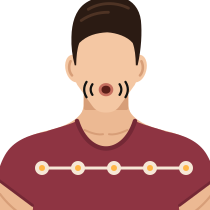
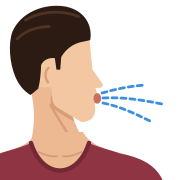
The mm-hmm test is a quick way to find your natural speaking pitch. Say a relaxed “mm-hmm”, the way you would casually agree with a friend, and notice the note and the buzz on your lips. That note is usually close to where your voice sits when it is relaxed. Then slide straight from it into words.
How to do mm-hmm
- Relax your face and jawLet your shoulders drop, unclench your teeth and breathe in easily through your nose.
- Say a casual “mm-hmm”Say “mm-hmm” as if a friend just said something you agree with. Don’t sing it or perform it: the less you try, the better.
- Notice the note and buzzRepeat it two or three times and notice the note it settles on and the buzz on your lips. That is your easy note.
- Slide straight into a wordWithout a break, go from the hum into a word on the same note: “mm-hmm… morning”, “mm-hmm… yes”, “mm-hmm… Monday”.
- Grow it into a phraseTry short phrases from the same starting point: “mm-hmm, more or less”, “mm-hmm, sounds good”. Let the melody move naturally after the first word.
- Compare with your usual voiceSay a sentence the way you normally would. If it starts higher and tighter, or pressed down and rattly, go back to the mm-hmm and start again.
Your cue: Say a relaxed “mm-hmm”, like agreeing. That's your easy note.
What it should feel like
It should feel like almost nothing: an easy, lazy sound with a light tickle on your lips and no effort in your throat. The words that follow should feel as easy as the “mm-hmm” itself. If the first word jumps up in pitch, or your throat tightens as you start speaking, go back to the hum and slide across more slowly.
Why it helps
When you agree with someone without thinking, you aren’t trying to sound any particular way, so your voice tends to land where it is most relaxed. NHS speech therapists use this “mhm” as a starting point for finding an easy, buzzy voice (North Cumbria NHS), and others begin voice exercises by humming at the pitch that feels most natural, then chanting simple “m” words from it (Dorset County Hospital NHS).
Why bother? When you are nervous or trying hard, your voice can drift above that relaxed note; when you are trying to sound deeper, you may push it below. Both take effort. ASHA advises against changing your pitch without a skilled voice professional, because doing it alone may lead to misuse (ASHA). The mm-hmm doesn’t move your pitch anywhere new: it helps you find the comfortable note you already have and start your sentences from it.
Treat it as a quick check, not a measurement. There is little direct research on the mm-hmm itself, and your easy note will shift a little from day to day: the goal is ease, not a number on a tuner. In the app it is the core of Day 15, “Find your easy note”, and it pairs well with the chest hum. If you are working on gender-affirming voice change, a speech-language therapist who specializes in it can guide pitch work safely, since unguided changes can encourage strain (ASHA).
Common mistakes
- Performing the mm-hmmA sung or exaggerated “mm-hmm” lands on a made-up note. Say it the way you really would, almost under your breath.
- Pushing it lower on purposeIf you drop the note to sound deeper, it stops being your easy note. Let it land where it lands.
- Pausing before the wordA gap lets your old habit back in. Slide straight from the hum into the word on the same breath.
- Chasing a number on a tunerDon’t hunt for a particular frequency in a pitch app. The feeling of ease is the guide.
Make it easier or harder
Easier
Just repeat the “mm-hmm” several times without adding words, with a fingertip on your lips to feel the buzz.
A step further
Use it in real life: before you answer the phone or speak up in a meeting, do a quiet “mm-hmm” under your breath and start your first word from that note.
Safety: Never force the note down or use creak to sound deeper, and stop if your throat feels tight or scratchy. If you have been hoarse for weeks, see a doctor or a speech-language therapist instead of searching for a new pitch.
Where it fits
In the DEEP VOICE app, mm-hmm: find your natural pitch is part of 2 ready-made warm-ups:
- Before a call (6½ min): A warm, steady voice for the phone or a video call.
- Resonance builder (7½ min): Find the buzz and move your voice out of your throat.
Read more in Deep voice exercises, Resonance exercises for your voice, Vocal warm-up for speaking and Sound more confident when you speak.
Questions people ask
How do I find my natural speaking pitch?
Say a relaxed “mm-hmm” as if casually agreeing with someone, and notice the note it lands on. That is usually close to your natural speaking pitch. Slide straight from it into a word, then a phrase, and compare it with the voice you normally use.
Is my natural pitch the same as my lowest note?
No. Your natural speaking pitch sits comfortably above the bottom of your range, where your voice is easy and clear. Speaking at the very bottom tends to sound creaky and tires the voice.
Can I change my natural pitch?
Your pitch range depends mostly on anatomy and hormones, so exercises won’t move it much. What you can learn is to speak at the relaxed end of your comfortable range instead of a tense, raised pitch. For bigger pitch changes, including gender-affirming voice work, see a specialist speech-language therapist.
What if my mm-hmm is higher than my normal voice?
That can happen if you usually push your voice down to sound deeper. Try speaking from the mm-hmm note for a day and notice whether your throat feels easier. Comfortable beats low.
Sources
- Speech and language: humming, North Cumbria Integrated Care NHS Foundation Trust
- Easy onsets, Dorset County Hospital NHS Foundation Trust
- Voice disorders: Practice Portal, American Speech-Language-Hearing Association (ASHA)
- Gender-affirming voice and communication: Practice Portal, American Speech-Language-Hearing Association (ASHA)
Your voice, safely
- Stay in your comfortable range. Never push your voice below what feels easy.
- No pressing on your throat or voice box, and no vocal fry or creak as a technique.
- Stop if it hurts or feels hoarse, scratchy or tired. Drink water and rest your voice.
- Hoarse for more than four weeks (sooner if you smoke), pain when you speak or trouble breathing? See an ENT doctor or a speech-language therapist.
These exercises are voice practice, not medical treatment. More on voice safety.