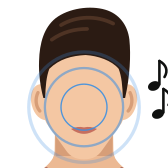
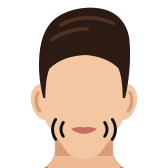
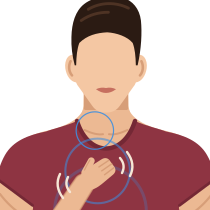
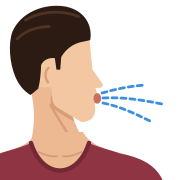
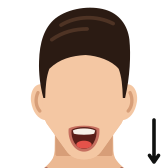
Hum into vowels is a humming exercise from resonant voice therapy. You hum until you feel a buzz on your lips, then open the hum into a vowel (“mmm-ah”) and into words that start with m (“mmman”, “many”) while keeping the buzz. It teaches you to carry the easy, forward feeling of a hum into speech, so your voice sounds fuller with less effort.
How to do hum into vowels
- Find your humLips gently closed, teeth slightly apart, tongue relaxed. Hum “mmm” on a comfortable note, about where you’d say “mm-hmm” to a friend, until you feel a buzz on your lips.
- Open into a vowelKeep the buzz and open your mouth slowly into “mmm-ah”. Try to keep the vibration on your lips and the front of your face as the vowel opens.
- Go through the vowelsRepeat with “mmm-ee”, “mmm-oh”, “mmm-oo” and “mmm-ay”, one easy breath for each.
- Hum into wordsNow words that start on the hum: “mmman”, “mmmoon”, “mmmore”, “many”, “morning”. Lengthen the m at first, then a little less each time.
- Try a short sentenceSay a sentence full of m and n sounds, like “My mother makes muffins on Monday”, keeping the same buzz all the way through.
- Reset when it slipsIf the buzz disappears and the sound drops back into your throat, go back to the plain hum and open again, more gently.
Your cue: Hum “mmm”, then open into “ah”. Keep the buzz as you open.
What it should feel like
A good hum tickles. Your lips buzz, and you may feel it on the bridge of your nose or your cheeks too. When you open into the vowel, the sound seems to stay at the front of your face instead of falling back into your throat, and your throat itself feels quiet, with no squeeze or push. The voice sounds clear and full rather than loud. If you feel nothing at all, hum a little more softly: the buzz comes from ease, not effort.
Why it helps
Resonant voice therapy aims for what ASHA describes as the strongest, cleanest voice for the least effort, guided by easy voicing and the vibrations you feel in your mouth and face. Humming is the usual starting point because closed lips make the buzz easy to notice. The Cambridge University Hospitals humming leaflet climbs the same ladder: a comfortable hum, then hum plus vowel, then m-words, phrases and sentences, in short sessions a few times a day.
Moving into words is the point: a hum alone doesn’t change how you talk, but carrying its buzz into vowels and words does. Day 16 of the challenge, Hum into words, takes it into a full paragraph read aloud, and the resonance exercises guide shows where it fits with the rest.
On evidence: resonant voice therapy is widely used by speech-language therapists, but studies of humming drills alone are small. In a 2017 study of 30 healthy speech-language therapy students, six weeks of resonant voice training with nasal consonants improved a combined voice-quality score within that group, though the groups didn’t clearly differ over time. The full method is taught by a therapist; this is a simplified version for practice alone.
Common mistakes
- Pushing the hum lowForcing a low hum makes the throat work and kills the buzz. Hum where it’s easy: a comfortable note buzzes more than a forced low one.
- Clenching your teethTeeth pressed together dampen the sound and tighten the jaw. Keep your lips closed but your teeth slightly apart.
- Losing the buzz on the vowelOpening too fast or too wide drops the sound back into your throat. Open slowly and keep the mouth shape relaxed.
- Humming too loudlyLouder isn’t more resonant. A soft hum often buzzes more clearly than a loud one.
Make it easier or harder
Easier
Stay with the plain hum and “mmm-ah” for a few days before adding words. Resting a fingertip on your lips helps you notice the buzz.
A step further
Read a short paragraph aloud and keep the buzz on every m and n, then on every vowel. Record it and listen for where the sound slips back into your throat.
Safety: Keep the hum soft and on a note that feels easy, and stop if your throat tightens or feels uncomfortable.
Where it fits
In the DEEP VOICE app, hum into vowels is part of this ready-made warm-up:
- Resonance builder (7½ min): Find the buzz and move your voice out of your throat.
Read more in Deep voice exercises, Resonance exercises for your voice and Voice projection exercises.
Questions people ask
Are humming exercises good for your voice?
For most people, yes. Humming is gentle and is used in voice therapy to help the vocal folds come together softly. Keep it comfortable and short, a few minutes at a time, and stop if anything hurts or you go hoarse.
Will humming make my voice deeper?
Humming doesn’t change the pitch your anatomy gives you. It can make your voice sound fuller and warmer, which many people hear as deeper, and it helps you speak on your easy note instead of a tense, raised one. If you’re working on your voice as part of a gender transition, a speech-language therapist who does gender-affirming voice work is the best guide; this is general voice practice.
Where should I feel the vibration when humming?
Mostly on your lips, and often on the bridge of your nose and your cheeks; some people feel it in the chest too. If you feel it mainly as pressure in your throat, hum more softly.
What is resonant voice therapy?
It’s a voice-therapy approach that trains an easy, buzzy, forward voice by feel rather than by effort, starting from humming and building up to conversation. A speech-language therapist teaches the full method; this exercise is a simplified piece of it.
Sources
- Humming exercises, Cambridge University Hospitals NHS Foundation Trust
- Voice disorders (Practice Portal), American Speech-Language-Hearing Association
- Short-term effect of two semi-occluded vocal tract training programs on the vocal quality of future occupational voice users: “resonant voice training using nasal consonants” versus “straw phonation”, Journal of Speech, Language, and Hearing Research (Meerschman et al., 2017)
Your voice, safely
- Stay in your comfortable range. Never push your voice below what feels easy.
- No pressing on your throat or voice box, and no vocal fry or creak as a technique.
- Stop if it hurts or feels hoarse, scratchy or tired. Drink water and rest your voice.
- Hoarse for more than four weeks (sooner if you smoke), pain when you speak or trouble breathing? See an ENT doctor or a speech-language therapist.
These exercises are voice practice, not medical treatment. More on voice safety.