Humming exercises use a gentle “mmm”, lips closed and teeth apart, to find an easy, buzzy voice. You hum on a comfortable note, feel the vibration on your lips, nose and cheeks, then carry that ease into vowels and words. Speech therapists use humming because it lets the vocal folds come together softly, without pushing, and helps build resonance.
How to do humming
- Get comfortable and breatheSit or stand comfortably with your shoulders loose. Breathe in quietly through your nose and let the breath settle low.
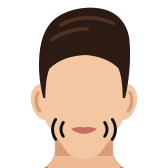
- Close lips, keep teeth apartLet your lips rest together lightly while your back teeth stay slightly apart and your tongue lies relaxed.
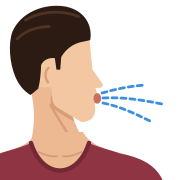
- Hum on an easy noteHum a quiet “mmm” on a note that feels comfortable, roughly where you’d say “mm-hmm” to a friend. Keep it smooth, not loud.
- Find the buzzNotice the vibration on your lips, then around your nose and cheekbones. Rest a fingertip lightly on your lips or cheek if it helps you feel it.
- Slide gently up and backGlide the hum slowly a little higher and back down again, staying in your easy range. Keep the buzz in the same place as the note moves.
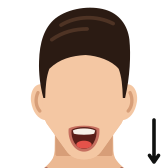
- Open into a wordFinish a few hums by opening into a vowel or a word without losing the buzz: “mmm-ah”, “mmm-more”, “mmm-morning”.
Your cue: Lips closed, teeth apart. Hum and feel the buzz.
What it should feel like
A good hum tickles. Your lips should buzz, and you may feel a hum around the bridge of your nose and your cheekbones. Your throat should feel loose, as if the sound were floating out rather than being pushed. If the buzz disappears and you feel the sound mainly in your throat, hum more quietly and let your jaw drop a little behind your closed lips.
Why it helps
Humming is a building block of resonant voice therapy, which aims for a clear, strong voice made with as little effort and vocal fold impact as possible (ASHA). NHS speech therapists explain that a hum lets the vocal folds come together softly, which helps smooth voicing, and that better resonance can help you get louder without forcing (Cambridge University Hospitals NHS). The buzz on your lips is the feedback: when it is there, the sound is usually being made efficiently.
Humming is also the gentlest exercise of its kind. When researchers measured mouth pressure across thirteen of these partly closed exercises, a plain “mmm” produced the least, about a tenth of a straw in water (Journal of Singing review, 2021). That makes it a good first exercise and cool-down, though less of a workout than a straw. In a small randomized trial with 30 healthy student speech therapists, six weeks of resonant voice training with “m” and “n” sounds improved one objective voice score within that group, but the differences between groups were not significant (Meerschman et al., 2017).
What humming won’t do is lower your pitch: how high or low your voice sits depends mostly on your anatomy. What a daily hum can change is how full and easy your voice sounds, with less squeeze in the throat, more buzz in the face, and a note at the relaxed end of your range. For a buzz you can feel in your chest, try the chest hum. To carry the hum into speech, go to hum into vowels, or see the resonance exercises guide.
Common mistakes
- Clenching the teethClosed lips don’t mean a closed jaw. Keep a little space between your back teeth so the sound has room.
- Humming too loudlyLoud humming pushes the throat. A soft, steady hum gives a clearer buzz.
- Chasing the lowest noteHum where it feels easy. A note forced down rattles, loses its buzz and tires the voice.
- Losing the buzz on wordsIf the buzz vanishes when you open into a vowel, go back to the hum and open more slowly and gently.
Make it easier or harder
Easier
Start with a relaxed “mm-hmm”, as if agreeing with someone, and simply stay on the “mmm”. Humming into a cup held near your mouth makes the vibration easier to feel.
A step further
Hum a few lines of a song, then read “My mom makes muffins on Monday mornings” with the same buzz.
Safety: Keep the hum quiet, and stop if you feel strain, discomfort or a tickle that makes you cough. Humming should never hurt.
Where it fits
In the DEEP VOICE app, humming is part of 2 ready-made warm-ups:
- Morning voice (6½ min): Wake a sleepy voice gently, without forcing it.
- Resonance builder (7½ min): Find the buzz and move your voice out of your throat.
Read more in Deep voice exercises, Resonance exercises for your voice and Vocal warm-up for speaking.
Questions people ask
Do humming exercises make your voice deeper?
Not in pitch: that depends mostly on your anatomy. Humming can make your voice sound fuller and more relaxed, because it trains an easy, resonant sound without throat squeeze. Hum on a comfortable note, never forced low, and carry that ease into speech.
Is humming good for your voice?
Yes. Gentle humming is one of the most common exercises speech therapists give for strained or tired voices. It lets the vocal folds meet softly and helps you find resonance.
How long should I hum each day?
A minute as a warm-up is enough. NHS leaflets suggest short sessions of up to five minutes, three to five times a day, rather than one long session. Little and often works best.
Where should I feel humming?
Mostly on your lips, and often around your nose and cheekbones. On comfortable lower notes some people also feel it in the upper chest. If you only feel it in your throat, hum more softly and keep your teeth apart.
Sources
- Humming exercises, Cambridge University Hospitals NHS Foundation Trust
- Voice disorders: Practice Portal, American Speech-Language-Hearing Association (ASHA)
- Realizing the benefits of SOVTEs: a reflection on the research (Hijleh and Pinto, 2021), Journal of Singing, NATS
- Short-term effect of two semi-occluded vocal tract training programs on the vocal quality of future occupational voice users (Meerschman et al., 2017), Journal of Speech, Language, and Hearing Research
Your voice, safely
- Stay in your comfortable range. Never push your voice below what feels easy.
- No pressing on your throat or voice box, and no vocal fry or creak as a technique.
- Stop if it hurts or feels hoarse, scratchy or tired. Drink water and rest your voice.
- Hoarse for more than four weeks (sooner if you smoke), pain when you speak or trouble breathing? See an ENT doctor or a speech-language therapist.
These exercises are voice practice, not medical treatment. More on voice safety.