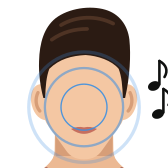
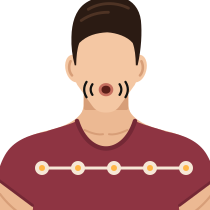
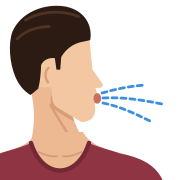
The chest hum is a chest resonance exercise: you rest a hand on your upper chest and hum “mmm” on a comfortable low note until you feel a buzz under your palm, then say a word on the same note. It teaches you what a relaxed, full voice feels like from the inside, so you can find it again when you speak.
How to do chest hum
- Hand flat on your chestRest one hand flat just below your collarbones. Let your shoulders drop and your jaw hang loose.
- Breathe in lowTake an easy breath through your nose so your belly moves out, rather than your shoulders lifting.
- Hum a comfortable low noteHum a gentle “mmm” in the lower part of your easy range: low enough to feel relaxed, never lower than feels easy. If the hum rattles or crackles, the note is too low, so move up a little.
- Feel the buzzNotice the vibration under your hand. Hum a few times and let it grow by relaxing, not by getting louder.
- Say “morning” on the noteWithout changing the note, open the hum into “mmm-morning”. Keep the buzz under your hand as the word comes out.
- Try more wordsDo the same with “many”, “more” and “Monday”, then a short phrase like “morning, everyone”.
Your cue: Hand on your chest. Hum a comfortable low note and feel it buzz.
What it should feel like
You should feel a soft, steady buzz under your palm and some vibration on your lips. Your throat should feel open and lazy, as if you were about to sigh. If you feel scratchy, run out of air quickly or hear a creak, you have gone too low or too loud: move the note up a little and soften it.
Why it helps
When you hum or speak on a relaxed note in the lower part of your range, the vibration spreads down into your chest, where you can feel it with your hand. NHS speech therapists use exactly this check: hum, rest a hand on your upper chest and notice the vibration (North Cumbria NHS). Another NHS leaflet starts by humming at the pitch that feels most natural and feeling for vibration in the lips, the bridge of the nose or the chest (Dorset County Hospital NHS).
Most of the sound people hear is amplified and shaped in your mouth and nose (Royal Berkshire NHS), so treat the chest buzz as a guide, not an amplifier. Speech therapists who work with people seeking a more masculine-sounding voice often include chest resonance as a goal, and warn that changing your voice without proper guidance can lead to strain and voice problems (ASHA). That is why this exercise asks for a comfortable low note, never the lowest one you can reach.
Be clear on what it changes. Your pitch range is set mostly by anatomy and hormones, and a chest hum can’t move it. It can help you speak from the relaxed lower part of your comfortable range, with more warmth and less throat tension, which is what most people mean by a deeper-sounding voice. For gender-affirming voice change, a specialist speech-language therapist is the best guide; this is general voice practice. Read more in how to get a deeper, fuller voice, or try it in Day 16 of the challenge.
Common mistakes
- Forcing the pitch downPressing the note down creates tension and often a creaky, rattly sound. Go back up to where the hum feels effortless.
- Pressing on your chestYour hand only listens. Pushing on your chest or throat adds nothing to the resonance.
- Humming louder to feel moreVolume doesn’t make the buzz richer. A relaxed, medium-soft hum usually gives the clearest vibration.
- Tucking the chinDropping your chin to sound deeper squeezes the throat. Keep your head level and your neck long.
Make it easier or harder
Easier
Lie on your back with a hand on your chest, or sigh out a soft “mmm” on a falling note and notice where it buzzes.
A step further
Read a paragraph aloud, pausing after each sentence to hum and check the buzz, then carry it into a real call or meeting.
Safety: Never press on your throat or force the note down, and don’t use vocal fry or creak to sound deeper. Stop if your voice feels scratchy or tired.
Where it fits
In the DEEP VOICE app, chest hum is part of 5 ready-made warm-ups:
- Pre-mission warm-up (5½ min): 5½ minutes of breath, release and resonance before today's mission.
- Before a call (6½ min): A warm, steady voice for the phone or a video call.
- Resonance builder (7½ min): Find the buzz and move your voice out of your throat.
- Full voice workout (9 min): Breath, release, resonance and projection. The complete set.
- One-minute reset (1 min): Voice tight or rushing? Sixty seconds back to low and slow.
Read more in Deep voice exercises, Resonance exercises for your voice, Vocal warm-up for speaking, Voice projection exercises and Sound more confident when you speak.
Questions people ask
What is chest resonance?
It is the vibration you feel in your chest when you hum or speak on a relaxed note in the lower part of your range. The feeling is a useful guide, even though most of the sound is shaped in your throat, mouth and nose.
How do you get more chest resonance?
Relax first: loose jaw, low breath, shoulders down. Then hum a comfortable low note with a hand on your chest and move straight into words on the same note. A slower pace helps far more than pushing your pitch down.
Will chest resonance exercises make my voice deeper?
They can make it sound deeper and warmer, but they won’t change your actual pitch range, which depends mostly on anatomy and hormones. The difference comes from speaking at the relaxed low end of your comfortable range instead of a tense, raised pitch.
Why does my voice crackle on the chest hum?
You are probably going too low or using too much air. Move the note up until the hum is smooth and easy. A clean, comfortable hum is always the target, never the lowest note you can reach.
Sources
- Speech and language: humming, North Cumbria Integrated Care NHS Foundation Trust
- Easy onsets, Dorset County Hospital NHS Foundation Trust
- Voice care tips for a healthy voice, Royal Berkshire NHS Foundation Trust
- Gender-affirming voice and communication: Practice Portal, American Speech-Language-Hearing Association (ASHA)
Your voice, safely
- Stay in your comfortable range. Never push your voice below what feels easy.
- No pressing on your throat or voice box, and no vocal fry or creak as a technique.
- Stop if it hurts or feels hoarse, scratchy or tired. Drink water and rest your voice.
- Hoarse for more than four weeks (sooner if you smoke), pain when you speak or trouble breathing? See an ENT doctor or a speech-language therapist.
These exercises are voice practice, not medical treatment. More on voice safety.