Clear speech means talking with crisp consonants, fully finished words, a natural melody and an unhurried pace, as if to a friend across a table in a busy café. It comes from Conversation Training Therapy, a voice-therapy approach. Speaking clearly tends to slow you down and makes you easier to understand without getting louder, which also spares your voice.
How to do clear speech
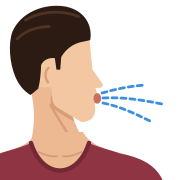
- Picture a busy caféImagine talking to a friend across a table in a noisy café. You want every word to land without raising your voice.
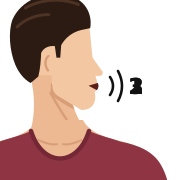
- Say a practice sentenceSay “Take a deep breath and take your time.” Make the t, k, p and d sounds crisp and light, like little taps.
- Finish every wordGive each word its ending, like the “th” in “breath” and the “d” in “and”. Don’t let words blur together or trail off.
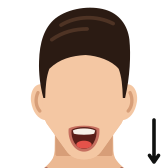
- Move your mouth a bit moreLet your lips and jaw move a little more than usual, but keep it natural. If it starts to feel like a face workout, you’ve gone too far.
- Keep the melody and paceKeep your normal up-and-down melody and an unhurried pace. Clear speech is relaxed and expressive, not slow and flat.
- Use it on your own wordsSay a few sentences about your day the same way, then something you’ll need later, like your name and why you’re calling.
Your cue: Crisp consonants, every word finished, no rush. Clear, not robotic.
What it should feel like
Your words feel crisp and complete, and your mouth feels a little more active than usual without any strain. Your pace slows on its own, because finishing words takes a moment. Your voice feels easier, not louder: clarity is doing the job that volume usually does. Listening back, every word is easy to catch and you still sound like yourself, just more awake.
Why it helps
Clear speech is one of six building blocks of Conversation Training Therapy, an approach developed with expert voice therapists that trains a healthy voice inside real conversation instead of starting from long sequences of drills. Clinicians simply cue patients to speak clearly; as a 2023 clinicians’ handout points out, that brings a slower rate and more precise consonants, which can make voicing easier.
In a 2019 study of adults with muscle tension voice problems or benign vocal fold lesions, people treated with Conversation Training Therapy improved more on a voice handicap questionnaire than matched patients from earlier years who had standard therapy, and needed fewer sessions. It wasn’t a randomized trial, and it tested the whole approach, not clear speech alone. The full method, which includes a step where patients deliberately use their old voice to feel the contrast, is taught by a speech-language therapist. This exercise leaves that step out and is a simplified version for practice alone.
Clear speech helps outside the clinic too. When people ask you to repeat yourself, the problem is often rushed or swallowed words rather than volume. Try crisper endings and a calmer pace before turning up the volume, then see voice projection exercises for carrying across a room. Day 68 of the challenge, Clear instructions, puts it into practice.
Common mistakes
- Over-articulatingExaggerated mouth shapes and spiky consonants sound robotic and tire your jaw. Aim for crisp, not theatrical.
- Getting louder insteadClear speech isn’t extra volume. Keep your normal, easy loudness and let the consonants do the work.
- Going slow and flatStretching every word and losing your melody sounds robotic. Keep a natural pace and your usual expression.
- Hitting consonants too hardPushed consonants make the throat work. Think of light taps of the tongue and lips.
Make it easier or harder
Easier
Start with one short sentence and focus only on finishing its last word. Then add crisp t and k sounds.
A step further
Read a short news article aloud as if to someone across a busy room, or record a 30-second voice note and check that every word is easy to catch on one listen.
Safety: Keep your volume at a normal, easy level and your jaw relaxed. If your throat or jaw starts to feel tired, stop and rest.
Where it fits
In the DEEP VOICE app, clear speech is part of this ready-made warm-up:
- Before a call (6½ min): A warm, steady voice for the phone or a video call.
Read more in Vocal warm-up for speaking, Voice projection exercises and How to speak slower.
Questions people ask
How can I speak more clearly?
Finish your words, make consonants crisp but light and slow your pace a little. Imagine talking to a friend across a noisy café table: clear enough to be understood the first time, without raising your voice.
What is Conversation Training Therapy?
It’s a voice-therapy approach that trains a healthy voice directly in conversation rather than through long sequences of drills. Clear speech is one of its six core parts. A speech-language therapist teaches the full method.
Why do people keep asking me to repeat myself?
Often it’s speed and swallowed word endings rather than volume. Try crisper endings and a slower pace before speaking louder. If people struggle to hear you even in quiet rooms, projection practice may help too.
Will speaking clearly make my voice sound deeper?
Not in pitch. But clear, unhurried speech sounds more grounded and confident, and that is a large part of what people hear as a deeper, fuller voice.
Sources
- The development of Conversation Training Therapy: a concept paper, Journal of Voice (Gartner-Schmidt et al., 2016)
- Efficacy of Conversation Training Therapy for patients with benign vocal fold lesions and muscle tension dysphonia compared to historical matched control patients, Journal of Speech, Language, and Hearing Research (Gillespie et al., 2019)
- Revamping your voice therapy toolbox (conference handout), Michigan Speech-Language-Hearing Association, 2023
Your voice, safely
- Stay in your comfortable range. Never push your voice below what feels easy.
- No pressing on your throat or voice box, and no vocal fry or creak as a technique.
- Stop if it hurts or feels hoarse, scratchy or tired. Drink water and rest your voice.
- Hoarse for more than four weeks (sooner if you smoke), pain when you speak or trouble breathing? See an ENT doctor or a speech-language therapist.
These exercises are voice practice, not medical treatment. More on voice safety.