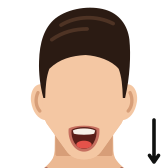
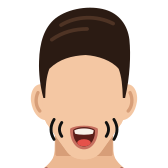
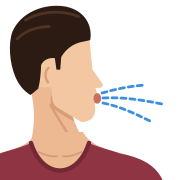
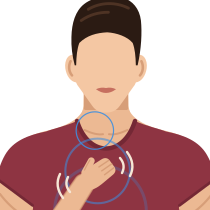
The vowel stretch is a resonance warm-up: you say the five vowels, A, E, I, O, U, slowly and on one easy note, with a relaxed, dropped jaw and big, round mouth shapes. Vowels carry most of the sound in speech, so giving them room helps your voice come out fuller and clearer instead of being squeezed through a tight mouth.
How to do vowel stretch
- Loosen your jaw firstLet your jaw hang slightly open, as if you are about to say “ah”. If it feels tight, massage the hinge of your jaw in small circles for a few seconds.
- Breathe in lowTake an easy breath through your nose and feel your belly move out.
- Say “ay” with an open mouthSay a long, unhurried “ay” on a comfortable note, jaw dropped and the tip of your tongue resting behind your bottom teeth. Hold it for about two seconds.
- Move through the vowelsContinue with “ee”, “eye”, “oh” and “oo”, about two seconds each. Make each shape clearly: wide for “ee”, open for “eye”, round for “oh”, small and round for “oo”.
- Keep the sound connectedKeep one smooth sound between vowels, without stopping your voice. Feel the vibration stay forward in your mouth as the shapes change.
- Add open wordsFinish with words built on open vowels, said slowly and fully: “far”, “more”, “own”, “alone”, “all of us”.
Your cue: A · E · I · O · U. Open, round and unhurried.
What it should feel like
Your mouth should feel roomy and your jaw heavy and loose, as if it is hanging rather than being held open. The sound should seem to fill your mouth and roll out, with a little buzz behind your front teeth. Watch in a mirror: your jaw should move for “ay” and “eye”, and your lips should round for “oh” and “oo”. If your jaw clicks, aches or feels stretched, open less.
Why it helps
Your mouth is part of your voice’s sound chamber: NHS speech therapists explain that your voice gains its loudness in the mouth and nose, where the tongue, teeth and lips shape it into speech (Royal Berkshire NHS). A clenched jaw and barely moving lips shrink that space, so the sound comes out thin and muffled. Jaw-drop and open-mouth exercises are used in voice therapy to release tension around the jaw and throat and to feel the space in your mouth (North Cumbria NHS).
Mouth opening and loudness go together. In an MRI study of 12 trained singers, both lip and jaw opening increased as they sang louder, and lip opening tracked loudness more closely than pitch (Echternach et al., 2016). That doesn’t make the vowel stretch a proven exercise in its own right; there is little direct research on it. But opening your mouth properly is one of the simplest ways to sound fuller and clearer without pushing.
The slow pace matters too. Stretching each vowel gives you time to notice tension, and gives a listener time to hear each word, which is why it leads naturally into clear speech and the speak slower guide. It is part of the app’s presentation, morning and resonance routines. Like every resonance exercise, it changes how full your voice sounds, not how high or low it is.
Common mistakes
- Forcing the jaw wide openOpen as far as is comfortable, not as far as possible. Strain in the jaw spreads to the throat.
- Smiling every vowelSpreading your lips wide for every vowel thins the sound. Keep “oh” and “oo” round and let “ay” and “eye” drop open.
- Getting loud instead of openThe vowels should get fuller from space, not from volume. Keep the sound medium-soft.
- Rushing through the fiveGive each vowel about two seconds. Speed brings back the small, tight mouth you are trying to leave behind.
Make it easier or harder
Easier
Do the mouth shapes silently in a mirror first, then add a soft, breathy sigh on each vowel, and only then an easy voice.
A step further
Read a short paragraph aloud, giving every vowel its full shape and time, then read it again at your normal pace and keep some of the openness.
Safety: Open only as wide as feels comfortable, and stop if your jaw clicks, locks or aches. If jaw pain keeps coming back, check with a dentist or doctor.
Where it fits
In the DEEP VOICE app, vowel stretch is part of 3 ready-made warm-ups:
- Morning voice (6½ min): Wake a sleepy voice gently, without forcing it.
- Before a presentation (8 min): For a talk, a pitch or a toast: grounded, warm and clear.
- Resonance builder (7½ min): Find the buzz and move your voice out of your throat.
Read more in Deep voice exercises, Resonance exercises for your voice and Vocal warm-up for speaking.
Questions people ask
Do vowel exercises improve your voice?
They help you use the space in your mouth, which makes your voice sound fuller and your words clearer. On their own they are a simple warm-up rather than a researched therapy, so pair them with breathing and humming exercises.
Which vowels are best for resonance?
Open vowels like “ah” and “oh” give the most room in the mouth and are a good place to start. A rounded “oo” helps you feel the sound forward on your lips. Practicing all five keeps your mouth flexible.
What exercises help you speak more clearly?
Start with this vowel stretch to loosen your jaw and open your mouth, then practice crisp consonants at an unhurried pace, as in the app’s clear speech exercise. Mumbling usually comes from a tight jaw, small mouth movements and rushing, and all three improve with practice.
Should my jaw hurt after vowel exercises?
No. A gentle stretch is fine, pain is not. Open less, slow down, and stop if your jaw clicks or aches.
Sources
- Voice care tips for a healthy voice, Royal Berkshire NHS Foundation Trust
- Speech and language: deconstriction, North Cumbria Integrated Care NHS Foundation Trust
- Morphometric differences of vocal tract articulators in different loudness conditions in singing (Echternach et al., 2016), PLoS One
Your voice, safely
- Stay in your comfortable range. Never push your voice below what feels easy.
- No pressing on your throat or voice box, and no vocal fry or creak as a technique.
- Stop if it hurts or feels hoarse, scratchy or tired. Drink water and rest your voice.
- Hoarse for more than four weeks (sooner if you smoke), pain when you speak or trouble breathing? See an ENT doctor or a speech-language therapist.
These exercises are voice practice, not medical treatment. More on voice safety.