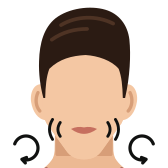
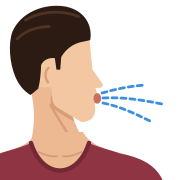
Jaw release is a simple warm-up: open your mouth as wide as is comfortable, hold briefly, then close and let your jaw hang completely loose, teeth apart and lips soft. Many people clench without noticing, especially under stress. A loose jaw gives the sound more room in your mouth and takes effort away from your throat, which helps your voice sound fuller and less pinched.
How to do jaw release
- Check for clenchingNotice whether your back teeth are touching. At rest they should be slightly apart, with your lips lightly closed and your tongue resting low in your mouth.
- Open comfortablyLet your jaw drop open as far as feels easy, as if about to say a slow “ah”. Hold for two or three seconds.
- Close and let goClose gently, then let your jaw hang heavy, teeth apart and lips just touching, as if it were too heavy to hold up.
- Stroke it downPlace your fingertips on your cheeks just in front of your ears and stroke slowly down to your jawline, letting the jaw drop a little further as you go.
- Repeat slowlyOpen, hold, release, five or six times over about 50 seconds.
- Talk with a loose jawSay “ma, ma, ma” or count to five, letting your jaw move freely with each sound.
Your cue: Open wide, then let your jaw hang loose.
What it should feel like
When you let go, your jaw feels heavy and your face softens, especially around the cheeks and temples. Your teeth are apart and your tongue may widen and settle. The open position feels roomy, never a strain at the hinge in front of your ears. Speaking afterward, the sound should seem to come out more easily, with less work in your mouth.
Why it helps
Your mouth is part of the space your voice resonates in. With a clenched jaw and the teeth close together, the sound has less room and the muscles around it tighten, which tends to make a voice thinner and more effortful. NHS speech and language therapists use jaw drops, stroking the jaw downward and imaginary chewing to release this tension so the voice comes more easily (Cambridge University Hospitals, North Cumbria NHS).
Clenching is often a stress habit: you may catch yourself doing it while concentrating, driving or before a difficult conversation. Releasing it on purpose before you speak, and checking for it during the day, teaches your jaw a new resting place. Once it’s loose, vowels open up naturally, which is the starting point for the vowel stretch and for resonance exercises.
As for evidence: jaw relaxation is a standard part of voice therapy and warm-ups, but little research has tested it on its own, and it won’t change your pitch. If you have jaw pain, clicking or trouble opening your mouth, keep the movement small: NHS advice for jaw joint problems includes not yawning too wide, and a dentist or doctor can check what’s going on.
Common mistakes
- Opening too wideForcing the jaw to its limit strains the joint. Open only as far as feels easy and roomy.
- Pushing the jaw forwardThe jaw should drop down and slightly back, not jut forward. Let gravity open it.
- Tensing the tongueKeep your tongue soft and low, with the tip resting behind your lower front teeth.
- Clenching again straight awayAfter the release, keep your teeth slightly apart while you talk and between sentences.
Make it easier or harder
Easier
Skip the wide opening and just practice the release: lips together, teeth apart, jaw heavy, for a few slow breaths.
A step further
Chew slowly and loosely with an empty mouth while humming, then count to ten with the same loose jaw, as in the chewing hum.
Safety: Never force your jaw open. If it clicks, locks or aches, keep the movement very small or skip it, and see a dentist or doctor if that keeps happening.
Where it fits
In the DEEP VOICE app, jaw release is part of 4 ready-made warm-ups:
- Pre-mission warm-up (5½ min): 5½ minutes of breath, release and resonance before today's mission.
- Before a call (6½ min): A warm, steady voice for the phone or a video call.
- Tension release (7 min): Unclench jaw, tongue, neck and shoulders.
- Full voice workout (9 min): Breath, release, resonance and projection. The complete set.
Read more in Deep voice exercises and Vocal warm-up for speaking.
Questions people ask
Can jaw tension affect your voice?
Yes. A clenched jaw shrinks the space in your mouth and adds tension around the throat, which can make your voice sound thin, pinched or tired. Releasing it is a common step in voice therapy and warm-ups.
How do I stop clenching my jaw when I talk?
Practice the release before you speak, then check in during the day: lips together, teeth apart, tongue resting low. A small reminder, like a note on your screen, helps many people catch the habit.
Does relaxing your jaw make your voice deeper?
It doesn’t change your natural pitch. It can make your voice sound fuller and warmer, because the sound has more room in your mouth and your throat works with less effort.
Should my teeth touch when my mouth is closed?
Usually not at rest. A relaxed jaw keeps the teeth slightly apart with the lips lightly together; the teeth meet briefly when you chew or swallow.
Sources
- Muscular flexibility exercise sheet, Cambridge University Hospitals NHS Foundation Trust
- Speech and language: deconstriction, North Cumbria Integrated Care NHS Foundation Trust
- Temporomandibular disorder (TMD), NHS
Your voice, safely
- Stay in your comfortable range. Never push your voice below what feels easy.
- No pressing on your throat or voice box, and no vocal fry or creak as a technique.
- Stop if it hurts or feels hoarse, scratchy or tired. Drink water and rest your voice.
- Hoarse for more than four weeks (sooner if you smoke), pain when you speak or trouble breathing? See an ENT doctor or a speech-language therapist.
These exercises are voice practice, not medical treatment. More on voice safety.