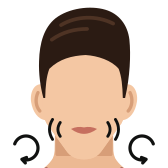
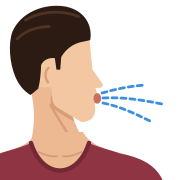
Tongue release is a gentle stretch: with your mouth relaxed, let your tongue slide out over your lower lip, rest it there for a breath, then let it fall back behind your bottom teeth. The root of the tongue sits just above your voice box and is linked to it, so a tense, pulled-back tongue can tighten your throat. Releasing it helps your voice come out more freely.
How to do tongue release
- Relax your mouthSit or stand tall with your jaw loose, teeth slightly apart and lips soft.
- Slide the tongue outLet your tongue slide gently forward and out over your lower lip. Keep it soft and wide rather than narrow and pointed.
- Rest it thereLet it lie on your lip for one slow breath through your nose. Don’t reach for distance: this is a release, not a stretch to the limit.
- Let it fall backLet the tongue slide back in and settle low in your mouth, its tip resting behind your bottom front teeth.
- Repeat gentlyDo it five or six times over about 50 seconds, keeping your jaw and neck still.
Your cue: Let your tongue slide out over your lip, then rest it back.
What it should feel like
Soft and a little odd, as if your tongue were a heavy, sleepy muscle lying on your lip. You may feel a mild stretch under your chin or toward the back of your mouth, and the back of your throat may feel more open. Your jaw stays loose and still. If the underside of your tongue or your jaw feels strained, you’re reaching too far.
Why it helps
The tongue is a large muscle, and much of it sits out of sight at the back of your mouth, just above your voice box. When it’s pulled back or held tight, it narrows the space your voice travels through and tends to drag the throat muscles into the effort. NHS speech and language therapists include tongue stretches, sticking the tongue out, holding it and moving it around, in exercises to ease throat tension so the voice is easier to produce (Cambridge University Hospitals) and in voice warm-ups (Royal Berkshire NHS).
Tongue tension is easy to miss. It can show up as a tongue pressed against the roof of your mouth or the back of your teeth, a tight feeling under your chin, or a sound that seems swallowed or muffled. Releasing it before you speak, and noticing where your tongue rests during the day, helps your voice feel freer and sound more open. The DEEP VOICE version stays deliberately gentle: a soft slide out, not a stretch as far as the tongue will go.
As for evidence: tongue exercises appear in NHS voice warm-ups and relaxation leaflets (North Cumbria NHS), but they haven’t been studied much on their own. Think of this as a quick way to let go of tension, not as a treatment. It pairs well with jaw release and the yawn–sigh.
Common mistakes
- Stretching to the limitPushing the tongue out as far as it goes makes it tense, which defeats the point. Let it slide out only as far as is easy.
- Pointing the tongueA narrow, pointed tongue is a working tongue. Let it lie wide and soft on your lip.
- Moving the jaw with itKeep the jaw loose and still; only the tongue moves.
- Holding your breathKeep breathing slowly through your nose while the tongue rests out.
Make it easier or harder
Easier
Leave the tongue inside: let it lie wide and soft on the floor of your mouth, tip behind your lower teeth, for a few slow breaths.
A step further
With your tongue resting forward on your lower lip, make a soft, easy “ah” on a comfortable note. Then bring the tongue back in and say “ah” again, keeping the same open feeling.
Safety: Keep it gentle: no pulling the tongue with your fingers and no stretching to the limit. Stop if you feel pain under your tongue or in your jaw.
Where it fits
In the DEEP VOICE app, tongue release is part of 2 ready-made warm-ups:
- Tension release (7 min): Unclench jaw, tongue, neck and shoulders.
- Full voice workout (9 min): Breath, release, resonance and projection. The complete set.
Read more in Vocal warm-up for speaking.
Questions people ask
Can tongue tension affect your voice?
Yes. A tense or pulled-back tongue narrows the space at the back of your mouth and can tighten the throat, making the voice sound muffled or strained. Releasing it is part of many voice warm-ups.
Where should my tongue rest when I speak?
At rest, the tip sits lightly behind your lower front teeth and the body of the tongue lies soft and wide. While you talk it moves constantly, but it should keep returning to that relaxed position.
How do I know if my tongue is tense?
Common signs are a tongue pressed hard against the roof of your mouth or your teeth, a tight feeling under your chin, or a voice that sounds swallowed. Try the release and notice whether speaking feels any easier afterward.
How often should I do tongue exercises for my voice?
A short round before you speak is plenty, and you can repeat it whenever your voice feels tight. NHS leaflets favor short, regular practice over long sessions.
Sources
- Muscular flexibility exercise sheet, Cambridge University Hospitals NHS Foundation Trust
- Voice warm up and warm down, Royal Berkshire NHS Foundation Trust, Speech and Language Therapy
- Speech and language: deconstriction, North Cumbria Integrated Care NHS Foundation Trust
Your voice, safely
- Stay in your comfortable range. Never push your voice below what feels easy.
- No pressing on your throat or voice box, and no vocal fry or creak as a technique.
- Stop if it hurts or feels hoarse, scratchy or tired. Drink water and rest your voice.
- Hoarse for more than four weeks (sooner if you smoke), pain when you speak or trouble breathing? See an ENT doctor or a speech-language therapist.
These exercises are voice practice, not medical treatment. More on voice safety.