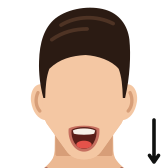
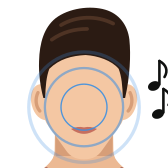
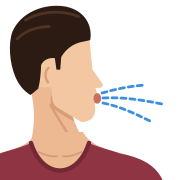
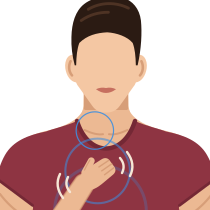
Chewing hum is a simplified version of the chewing method, a voice-therapy technique described by Emil Froeschels. With nothing in your mouth, you chew slowly and loosely while humming “mm-yum”, then count and talk as the chewing gets smaller. Chewing is a relaxed, familiar movement, so voicing on it helps loosen the jaw and tongue and makes the voice feel easier.
How to do chewing hum
- Empty mouth, loose jawMake sure there’s nothing in your mouth: no gum, no food. Let your jaw hang loose with your lips lightly together.
- Chew big and slowChew slowly as if on a big, soft bite of bread, letting your jaw, lips and tongue move freely. Lazy, not forceful.
- Hum while you chewAdd an easy hum on a comfortable note: “mm-yum, mm-yum, mm-yum”. Let the sound move with the chewing; it doesn’t have to stay on one note.
- Count while chewingKeep chewing and count from one to ten, letting the numbers come out chewy and relaxed.
- Make the chewing smallerCount again, making the movements a little smaller each round, until it’s just easy talking with a loose jaw.
- Say a real sentenceFinish with an ordinary sentence, keeping the looseness you found.
Your cue: Chew loosely with an empty mouth while humming “mm-yum”.
What it should feel like
It feels a bit silly and very relaxed, like lazily chewing with your mouth closed while murmuring to yourself. Your jaw swings freely, your tongue moves around, and the hum feels soft and buzzy instead of held in place. When you switch to counting, the words sound relaxed and slightly rounded. Your jaw joints should feel loose, never sore.
Why it helps
The method goes back to Emil Froeschels, who wrote about chewing as voice therapy in 1952. The idea is simple: chewing is a loose, automatic movement of the same jaw, lips and tongue you talk with, and voicing while you chew borrows that ease. Chewing still appears in NHS voice care: a North Cumbria NHS leaflet on releasing throat tension has you imagine chewing toffee that grows bigger with every chew, next to jaw and humming exercises.
Research is limited. In a pilot study of 27 healthy female speech-language therapy students, 18 weeks of chewing exercises improved several objective measures of voice quality and widened the voice range compared with a control group. Average speaking pitch went up, though, not down. So this is an exercise for a relaxed jaw and an easier, more resonant voice, not for deepening.
A clenched jaw and a stiff tongue squeeze the sound and make speaking feel like work. If that sounds like you, chewing hum fits well with jaw release and tongue release. The full chewing method is taught by a speech-language therapist; this is a simplified version for practice alone.
Common mistakes
- Chewing gum or foodReal gum or food makes you hold, swallow and tense up. Chew on nothing.
- Chewing hard or fastForceful chewing tightens the very jaw muscles you’re trying to loosen. Keep it slow, lazy and loose.
- Holding the hum rigidIf the jaw moves but the hum stays fixed and tight, your throat is holding on. Let the sound wobble with the chewing.
- Opening the jaw too wideHuge movements can strain the jaw joint. Make them big enough to feel loose, no bigger.
Make it easier or harder
Easier
Chew silently for a few rounds first, then add a very soft hum for only a few chews at a time.
A step further
Chew-talk your way through a short paragraph, then read it again with the chewing almost invisible and the looseness still there.
Safety: Use an empty mouth only, and stop if your jaw clicks, locks or aches. If you have a jaw joint problem, skip it or ask your dentist or doctor first.
Where it fits
In the DEEP VOICE app, chewing hum is part of this ready-made warm-up:
- Tension release (7 min): Unclench jaw, tongue, neck and shoulders.
Questions people ask
What is the chewing method in voice therapy?
It’s a technique, described by Emil Froeschels in the mid-20th century, in which you voice while making loose chewing movements and then gradually turn that into normal speech. Therapists use it to relax the jaw, tongue and throat. This page shows a simplified version for practice alone.
Does chewing make your voice deeper?
No. In a small pilot study, chewing practice raised average pitch rather than lowering it. Use it for a looser, easier and more resonant voice.
Why does my jaw get tight when I talk?
Stress, concentration and habits like clenching can all tighten the jaw, and a tight jaw squeezes the sound. A short release exercise before you speak helps many people. If jaw pain keeps coming back, see a dentist or doctor.
Can I chew gum instead?
No, use an empty mouth. With gum, your jaw works against something and you end up holding and swallowing instead of letting go.
Sources
- Chewing method as therapy: a discussion with some philosophical conclusions, AMA Archives of Otolaryngology (Froeschels, 1952)
- Effectiveness of chewing technique on the phonation of female speech-language pathology students: a pilot study, Journal of Voice (Meerschman et al., 2016)
- Speech and language: deconstriction, North Cumbria Integrated Care NHS Foundation Trust
Your voice, safely
- Stay in your comfortable range. Never push your voice below what feels easy.
- No pressing on your throat or voice box, and no vocal fry or creak as a technique.
- Stop if it hurts or feels hoarse, scratchy or tired. Drink water and rest your voice.
- Hoarse for more than four weeks (sooner if you smoke), pain when you speak or trouble breathing? See an ENT doctor or a speech-language therapist.
These exercises are voice practice, not medical treatment. More on voice safety.