Hiss to buzz is a breathing exercise for your voice. You breathe in low, let the air out on a smooth, even “sss”, then do the same on a “zzz”. The hiss trains a steady flow of air with a relaxed throat; the buzz puts your voice on top of that same steady flow. It’s adapted from NHS speech and language therapy breathing leaflets.
How to do hiss to buzz
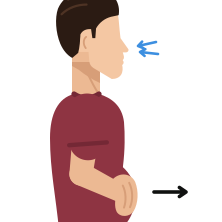
- Sit or stand tallSit upright with both feet on the floor, or stand with your weight even. Let your shoulders drop and rest one hand on your belly, just under your ribs.
- Breathe in low for threeBreathe in through your nose for a slow count of three. Feel your belly move out under your hand while your chest and shoulders stay quiet.
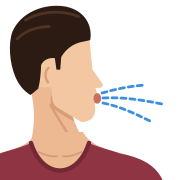
- Let it out on “sss”Let the air out on a smooth, quiet “sssss”, like a slow leak from a tire. Keep the same strength from start to finish and stop while you still have some air left.
- Breathe, then buzz on “zzz”Take another easy breath and do the same on “zzzzz”, feeling the buzz on your teeth and lips. Keep it as even as the hiss.
- Repeat three to five roundsAlternate hiss and buzz for three to five rounds, with a normal breath or two in between. If you feel dizzy, stop and breathe normally.
- Carry it into a sentenceFinish by saying one long sentence on a single easy breath, with the same steady flow behind the words.
Your cue: One easy breath on a steady “sss”, the next on a steady “zzz”.
What it should feel like
The hiss sounds like a steady leak, not a puff that fades. Your belly moves in slowly under your hand while your shoulders stay down. On the buzz you feel a light tickle on your front teeth and lips, and your throat feels no different from the hiss. If the “zzz” wobbles or turns rough toward the end, you went on too long: stop a little earlier next time.
Why it helps
Your voice runs on air: the vocal folds need a steady stream from below to vibrate evenly, and a thin or shaky voice is often short of an even flow rather than short of air. A Royal Berkshire NHS breathing leaflet uses this same pair of steps: voiceless sounds like “s” and “f”, which leave the throat relaxed because the voice box isn’t working, then voiced sounds like “z” and “v”, never straining at the end of a breath.
The move from hiss to buzz is the useful part. The hiss finds a smooth outflow with nothing else to think about; the buzz keeps that flow while your voice is on, which is what speaking needs. Many people notice here that they push the last of the air out with their throat, which is what makes sentence endings go quiet or tight. Day 9 of the challenge, The long exhale, builds on it, and how to speak from your diaphragm gives the bigger picture.
Sustained “s” and “z” sounds are standard in voice clinics, and Royal Papworth Hospital’s breathing leaflet also pairs a short in-breath with a longer “sss” and says to rest if you feel dizzy. There is little research on this exercise on its own, so treat it as a sensible, low-risk warm-up, not a treatment. It won’t change your pitch, but it can make your voice steadier and less likely to fade.
Common mistakes
- Holding it as long as possibleThis isn’t a contest, and squeezing out the last bit of air tightens your throat. Stop while the sound is still smooth.
- Starting strong, then fadingA blast at the start empties you fast. Start at a volume you can keep, like a quiet leak, and aim for even rather than long.
- Lifting your shouldersIf your shoulders rise as you breathe in, the breath is going high. Keep a hand on your belly and let that move instead.
- Pushing the buzzThe “zzz” should feel as easy as the “sss”. If your throat tightens, make the buzz quieter and let the air do the work.
Make it easier or harder
Easier
Do only the hiss for a few days, then add the buzz. Lying on your back with a hand on your belly makes low breathing easier to feel.
A step further
Try “fff” and “vvv”, or slide from hiss to buzz in the middle of one breath without a break: “sssszzzz”. Make it smoother, not longer.
Safety: Take normal breaths between rounds and stop if you feel light-headed or dizzy. Never squeeze out the last of the air.
Where it fits
In the DEEP VOICE app, hiss to buzz is part of this ready-made warm-up:
- Breath support (6 min): Breathe low so your voice has something to stand on.
Read more in Speak from your diaphragm.
Questions people ask
What is the hiss to buzz exercise good for?
It trains a steady, even flow of air, first without your voice and then with it. That steady flow keeps your volume up to the end of a sentence and stops your voice from sounding shaky. It’s a common first breathing exercise in voice clinics.
Is this the same as the s/z ratio test?
No. In the s/z ratio, a clinician times the longest “s” and “z” you can hold and compares them. Here you never hold for as long as possible: you stop while it’s still easy, because the goal is a smooth flow, not a record.
Can breathing exercises make your voice deeper?
They can’t change the pitch your anatomy gives you. Steady breath can make your voice sound fuller and calmer, because you stop running out of air and squeezing at the ends of sentences. That steadier sound is often what people mean by a deeper voice.
Sources
- Abdominal breathing, Royal Berkshire NHS Foundation Trust
- Breathing exercises to support speech (PI 163), Royal Papworth Hospital NHS Foundation Trust
Your voice, safely
- Stay in your comfortable range. Never push your voice below what feels easy.
- No pressing on your throat or voice box, and no vocal fry or creak as a technique.
- Stop if it hurts or feels hoarse, scratchy or tired. Drink water and rest your voice.
- Hoarse for more than four weeks (sooner if you smoke), pain when you speak or trouble breathing? See an ENT doctor or a speech-language therapist.
These exercises are voice practice, not medical treatment. More on voice safety.