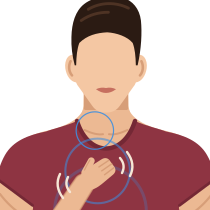
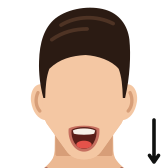
Breath pulses are a breathing exercise for your voice: with a hand on your belly, you let the air out on a soft “sss”, then pulse it out on “ha · ha · HA”, with a small inward bounce of the belly on each beat. They are inspired by the Accent Method, a voice therapy technique that coordinates breathing and voice so the belly, not the throat, drives the sound.
How to do breath pulses
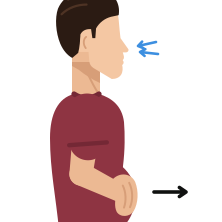
- Hands on belly and chestSit or stand tall with one hand on your belly, just below your ribs, and the other on your upper chest.
- Breathe in lowBreathe in easily through your nose so the belly hand moves out and the chest hand stays almost still.
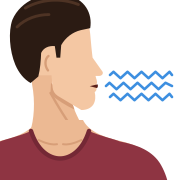
- Let it out on “sss”Breathe out on a soft, steady “sss” and feel your belly move gently in. No voice yet: this is the warm-up.
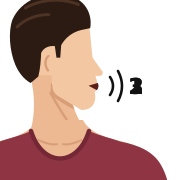
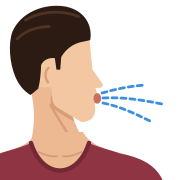
- Pulse “ha · ha · HA”Breathe in low again, then pulse the air out on “ha · ha · HA”, with a small, quick inward bounce of the belly on each beat and the last one a little stronger. Use an easy voice on a comfortable note.
- Start slow, then find a rhythmBegin with slow, even beats. Once your belly is clearly leading, let the rhythm get a little quicker and bouncier, like a relaxed march.
- Rest between roundsBreathe normally for a few seconds between rounds. Four to six rounds is enough.
Your cue: Hand on your belly. Pulse “ha · ha · HA” from the belly, slow and easy.
What it should feel like
Your belly hand should bounce in on every “ha” while your shoulders and chest stay quiet. The sound should feel as if the breath throws it out, light and springy, with no catch or click in your throat. The last “HA” is a little stronger, not shouted. If you feel effort in your throat, or the “ha” sounds harsh, make the pulses smaller and softer.
Why it helps
The Accent Method is a long-established voice therapy technique. ASHA describes its aims as increasing breath output, helping the vocal folds use that air more efficiently and reducing excess muscle tension, using abdominal breathing and rhythmic, accented vocal play that moves from simple sounds toward conversation (ASHA). An NHS leaflet teaches it in stages: low breathing, voiceless sounds like “sss”, voiced sounds on a comfortable note, then belly pulses, with the effort coming from the stomach muscles and not the throat (North Cumbria NHS).
The point is coordination. When the belly starts each pulse, the throat doesn’t have to squeeze to make the sound, which is what people usually mean by “speaking from your diaphragm”. The method works with rhythms at three tempos, slow, medium and fast (Ge et al., 2023, a study of the method in people with speech difficulties after a stroke). DEEP VOICE uses a simplified version for practice on your own; the full method is taught by a speech-language therapist.
There is little research on a stripped-down drill like this one in healthy speakers, so treat it as practice for a skill rather than a treatment. Breath pulses won’t change your pitch, but they make the link between breath and voice something you can feel, which helps with projection and a steadier delivery. Learn the low breath itself with belly breathing, and read how to speak from your diaphragm.
Common mistakes
- Pushing from the throatIf the “ha” sounds harsh or clicks, your throat is doing the work. Make the pulse smaller and let the belly lead.
- Breathing too fastRushed, big breaths can make you dizzy. Take an easy breath and rest between rounds.
- Shoulders bouncing insteadOnly the belly should move. Keep the chest hand still and your shoulders down.
- Shouting the last “HA”The final beat is a little stronger, not loud. Keep it at a comfortable speaking level.
Make it easier or harder
Easier
Do the pulses on air only, “ss · ss · SS” or “ff · ff · FF”, before adding your voice, and keep the rhythm slow.
A step further
Pulse through a short phrase, one belly bounce per stressed word (“I’m HERE to TALK about it”), then say it normally with the same support.
Safety: Stop and rest if you feel dizzy or light-headed, and don’t rush your breathing. Stop if you feel effort or strain in your throat.
Where it fits
In the DEEP VOICE app, breath pulses is part of this ready-made warm-up:
- Breath support (6 min): Breathe low so your voice has something to stand on.
Read more in Speak from your diaphragm and Voice projection exercises.
Questions people ask
How do I speak from my diaphragm and not my throat?
Breathe in low so your belly moves out, then let the belly move in to power the sound while your throat stays relaxed. Breath pulses make this easy to feel, because your hand bounces on each “ha”. Then carry the same low support into short spoken phrases.
What are good breathing exercises for your voice?
Belly breathing teaches low, relaxed breaths, a slow exhale or a steady “sss” trains control, and breath pulses connect the breath to your voice. Practice little and often, a few minutes at a time.
What is the Accent Method?
It is a voice therapy technique that coordinates abdominal breathing with rhythmic, accented sounds, moving from slow to faster rhythms and from sounds to speech. It is usually taught by a speech-language therapist. This exercise is a simplified version for practicing on your own.
Why do I feel dizzy doing breathing exercises?
Breathing more deeply or quickly than usual can make you light-headed. It isn’t harmful, but it is a sign to slow down: rest, breathe normally and make the next round gentler.
Sources
- Voice disorders: Practice Portal, American Speech-Language-Hearing Association (ASHA)
- Speech and language: Accent Method, North Cumbria Integrated Care NHS Foundation Trust
- Speech and language: diaphragmatic breathing, North Cumbria Integrated Care NHS Foundation Trust
- The combination of accent method and phonemic contrast: an innovative strategy to improve speech production on post-stroke dysarthria (Ge et al., 2023), Frontiers in Human Neuroscience
Your voice, safely
- Stay in your comfortable range. Never push your voice below what feels easy.
- No pressing on your throat or voice box, and no vocal fry or creak as a technique.
- Stop if it hurts or feels hoarse, scratchy or tired. Drink water and rest your voice.
- Hoarse for more than four weeks (sooner if you smoke), pain when you speak or trouble breathing? See an ENT doctor or a speech-language therapist.
These exercises are voice practice, not medical treatment. More on voice safety.