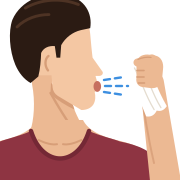
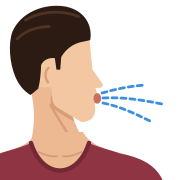
Easy onset, also called soft onset, is a voice-therapy technique for starting your voice gently. Words that begin with a vowel, like “apple” or “open”, often start with a hard click or bump in the throat. You first put a tiny breath of “h” before the vowel (“h-apple”), then fade the “h” away and keep the same soft start.
How to do easy onset
- Notice your usual startSay “apple, every, open” the way you normally would, and notice whether each word begins with a little click or catch in your throat.
- Sigh some h-wordsSay real h-words on a gentle, breathy sigh, as if beginning a yawn: “ha”, “home”, “hello”.
- Add a tiny “h” to vowelsNow say “h-apple”, “h-every”, “h-open”, “h-always”: a breath of air first, then the vowel slides in softly.
- Make the “h” smallerRepeat, making the “h” smaller each time, until you can barely hear it.
- Drop the “h”Say “apple”, “every”, “open” with no “h” at all, but with the same soft start, as if air and voice begin together.
- Use it in phrasesTry “How are you?”, “I’m on my way” and “Every evening I open all the windows”, starting each vowel softly.
Your cue: Start each word on a whisper of air: h-apple, h-every, h-open.
What it should feel like
Each word seems to glide in on the breath, with no catch, click or little cough in your throat. With the “h” you hear a tiny breath before the vowel; without it you hear none, but the word still starts softly and clearly. Your throat feels relaxed and your voice sounds calm rather than abrupt. If the whole word comes out breathy, the “h” was too big.
Why it helps
A hard start, often called a hard glottal attack, happens when the vocal folds close tightly before the sound and then burst apart. Now and then it’s harmless, but as a habit it adds effort and makes speech sound tense or clipped; ASHA lists hard glottal attacks among the voice behaviors therapists look at. An expert consensus on voice therapy includes starting the voice with /h/ as a therapy ingredient, and the flow phonation trial by Rangarathnam and colleagues used practice phrases beginning with “h” and “wh”.
The Dorset County Hospital NHS vocal tract relaxation leaflet works the same way: say h-words on a gentle, breathy sigh as if starting a yawn, then short phrases, with the aim of bringing the vocal folds together gently. Here the final step matters most. You drop the “h” and keep the soft start, so it becomes your normal way of beginning words instead of a breathy add-on.
Easy onset is about how your voice starts, not its pitch, but a smooth start is a big part of sounding steady and in control, especially when nerves make your first words come out sharp. See how to sound more confident when speaking for more. Speech-language therapists teach it within fuller programs; this is a simplified version for practice alone.
Common mistakes
- Making the “h” too bigA big, airy “h” turns into a breathy voice that tires you out. Keep it to a whisper of air, then fade it.
- Breathy all the way throughOnly the very start should be soft. Once the vowel begins, let your voice be clear.
- Gulping air before speakingA big gasp before the word tightens the throat. Take a small, low breath and start speaking as the air begins to flow out.
- Never dropping the “h”The “h” is a stepping stone. Practice until the soft start works without it, or people will hear “h-apple”.
Make it easier or harder
Easier
Stay with real h-words like “hello”, “home” and “happy” on a gentle sigh for a few days before moving on to vowel words.
A step further
Mark every word that starts with a vowel in a paragraph, then read it aloud with a soft start on each one. Use it on the first sentence of every call.
Safety: Keep the “h” small, and rest if you feel light-headed from too much airflow. Stop if your throat feels tight or sore.
Where it fits
In the DEEP VOICE app, easy onset is part of 2 ready-made warm-ups:
- Calm voice (6½ min): Slow your breath and soften a tight throat before something tense.
- Tension release (7 min): Unclench jaw, tongue, neck and shoulders.
Read more in Sound more confident when you speak.
Questions people ask
What is easy onset in voice therapy?
Easy onset, or soft onset, means starting your voice gently, with air and voice beginning together instead of a hard click in the throat. Therapists often teach it with an “h” before vowels, then fade the “h” away.
What is a hard glottal attack?
It’s a sharp, clicky start to a word that begins with a vowel, caused by the vocal folds pressing shut and then bursting open. Most people do it now and then; as a constant habit it adds strain and sounds tense.
How do I stop my voice sounding harsh or abrupt?
Start words gently, take a small, low breath before you speak and slow down a little. Easy onset, humming and slower pacing all help. If the harshness comes with pain, or hoarseness that lasts more than four weeks, see an ENT doctor or a speech-language therapist.
Sources
- Voice therapy according to the Rehabilitation Treatment Specification System: expert consensus ingredients and targets, American Journal of Speech-Language Pathology (Van Stan et al., 2021)
- Vocal tract relaxation exercises, Dorset County Hospital NHS Foundation Trust
- A randomized controlled trial of the effects of flow phonation voice treatment for primary muscle tension dysphonia, Journal of Communication Disorders (Rangarathnam et al., 2023)
- Voice disorders (Practice Portal), American Speech-Language-Hearing Association
Your voice, safely
- Stay in your comfortable range. Never push your voice below what feels easy.
- No pressing on your throat or voice box, and no vocal fry or creak as a technique.
- Stop if it hurts or feels hoarse, scratchy or tired. Drink water and rest your voice.
- Hoarse for more than four weeks (sooner if you smoke), pain when you speak or trouble breathing? See an ENT doctor or a speech-language therapist.
These exercises are voice practice, not medical treatment. More on voice safety.