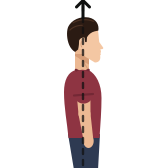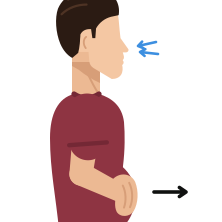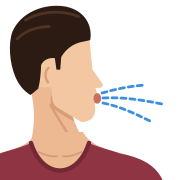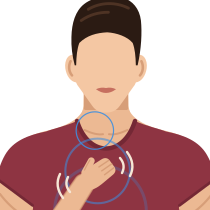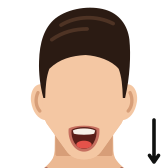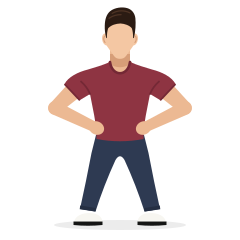
A power pose is an open stance: feet apart, hands on hips, chest open, chin level. Held for a minute before you speak, it gives you a quiet moment to settle and breathe low into your belly. The famous claim that it raises testosterone and lowers cortisol didn’t hold up in larger studies. What does seem to hold is that people feel a little more confident.
How to do power pose
- Find a private spotA restroom, a stairwell or an empty room is fine. You want one minute where you can stand still without feeling watched.
- Set your feetStand with your feet about shoulder-width apart, weight even on both feet and knees soft.
- Hands on hips, chest openRest your hands on your hips with your elbows out to the sides. Let the chest open by dropping your shoulders, not by puffing it out.
- Level your chinLook straight ahead with your chin level and your neck long. Don’t tip your head back.
- Breathe low for a minuteBreathe in slowly through your nose and let your belly move out, then let the air go gently. Keep every breath unhurried and comfortable, never forced bigger.
- Carry it into your first lineDrop your hands, keep the open chest and the low breath, and say your opening sentence once, slowly, before you walk in.
Your cue: Feet planted, hands on hips, chest open. Breathe low.
What it should feel like
Steady and a little taller, with your weight sinking into the floor through both feet. Your breathing feels slow and low, around your waist rather than up at your collarbones. It shouldn’t feel like a strain or a performance: if you notice clenched fists, shoulders pulled back hard or a held breath, soften until it’s simply an open, comfortable way of standing.
Why it helps
The idea became famous after a small 2010 study reported that holding an expansive pose raised testosterone, lowered cortisol and made people take more risks. In 2015 a team led from the University of Zurich repeated the experiment with 200 people and found no effect on either hormone or on risk-taking, although people in the open pose did report feeling more powerful (University of Zurich). The original lead author later said she no longer believed the effects were real, and a 2021 review in The Psychologist sums up where things stand: an effect on how powerful people feel, but nothing reliable on hormones or behavior.
So why does DEEP VOICE keep it? Because the useful part for your voice is not the pose but what you do in it: one minute of standing still, open and unhurried, while you breathe low. Low, slow breathing is the foundation of a steady voice (see belly breathing), and a stance that stops you hunching makes that easier. The same review notes that the benefit may come more from not collapsing into a closed, hunched posture than from forcing a big one, which fits the aim here: open and easy, not big.
Think of it as a ritual that helps some people feel ready, not as a guarantee. If hands on hips makes you feel silly, skip them and do a posture reset with a few slow breaths instead; you lose nothing. In the app it sits in the Before a presentation routine, right after box breathing.
Common mistakes
- Expecting a hormone boostThe hormone findings didn’t replicate. Use the minute to breathe and settle, and judge it by how you feel.
- Puffing the chest outA forced chest lifts your shoulders and pulls your breath up high. Open the chest by letting your shoulders drop.
- Holding your breathWhen people stand still they often freeze their breathing. Keep it moving, slow and low, the whole minute.
- Tipping the head backA raised chin tightens the front of your neck. Keep your gaze level.
Make it easier or harder
Easier
Do it sitting: lean back slightly, rest your hands open on your thighs and simply breathe low and slowly for a minute.
A step further
After the minute, keep the stance and say your first three sentences out loud at an unhurried pace, breathing low at the end of each one.
Safety: Keep the breathing gentle: if you feel lightheaded, go back to normal breathing and sit down. Keep your knees soft so you don’t lock them.
Where it fits
In the DEEP VOICE app, power pose is part of this ready-made warm-up:
- Before a presentation (8 min): For a talk, a pitch or a toast: grounded, warm and clear.
Read more in Vocal warm-up for speaking.
Questions people ask
Does power posing actually work?
Not in the way it was first claimed. Larger studies found no change in testosterone, cortisol or risk-taking, though people often report feeling a little more powerful. It’s best used as a moment to calm down and breathe, not as a biological boost.
How long should you hold a power pose?
There’s no proven ideal length. In DEEP VOICE it’s one minute, which is enough to settle your stance and take several slow, low breaths.
Should I do a power pose before an interview?
If it helps you feel steady, yes, somewhere private. Pair it with slow breathing and say your first sentence out loud once before you go in. If there’s nowhere private, a posture reset and a slow exhale in your seat do much the same job.
Does a power pose make your voice sound more confident?
Not directly. What helps your voice is what you do during it: low breathing, loose shoulders and a slower start. Those make a voice sound steadier, and steadiness is much of what listeners hear as confidence.
Sources
- Poses of power are less powerful than we thought, University of Zurich
- A decade of power posing: where do we stand?, The Psychologist, British Psychological Society
Your voice, safely
- Stay in your comfortable range. Never push your voice below what feels easy.
- No pressing on your throat or voice box, and no vocal fry or creak as a technique.
- Stop if it hurts or feels hoarse, scratchy or tired. Drink water and rest your voice.
- Hoarse for more than four weeks (sooner if you smoke), pain when you speak or trouble breathing? See an ENT doctor or a speech-language therapist.
These exercises are voice practice, not medical treatment. More on voice safety.