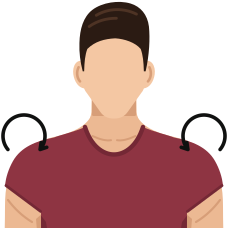
Neck release is the DEEP VOICE warm-up called “Tilt your head left & right”: let your head tilt gently so one ear moves toward its shoulder, hold for a breath or two, then switch sides. It eases stiffness along the sides of your neck, where tension builds up with stress and screen time, so you start speaking without extra effort in your throat.
How to do neck release
- Sit or stand tallSpine long, shoulders low and relaxed, eyes looking straight ahead.
- Tilt toward one shoulderLet your right ear drift slowly toward your right shoulder, eyes still facing forward. The head moves; the shoulder stays down instead of rising to meet it.
- Hold for a breathStay there for one or two slow breaths and let the weight of your head do the stretch. You should feel a mild pull along the left side of your neck.
- Come back to centerLift your head slowly back to upright.
- Switch sidesTilt your left ear toward your left shoulder, hold for a breath and come back. Keep alternating for about 50 seconds.
- Let one arm hang heavyFor a little more stretch, let the arm on the far side hang heavy, as if you were holding a small child’s hand. Keep it gentle.
Your cue: Ear towards shoulder, hold, switch sides.
What it should feel like
A mild, even stretch along the side of your neck that softens as you breathe out, never a sharp, pinching or tingling feeling. Your jaw stays loose and your breathing keeps going. When you come back to center, your head should feel lighter and better balanced on top of your spine.
Why it helps
An easy voice needs a neck that isn’t braced. NHS speech and language therapists teach gentle ear-to-shoulder tilts as part of neck and shoulder exercises for people whose voice is strained by muscle tension, with the aim of more flexibility and less tension, not strength (North Cumbria NHS). The West Suffolk NHS voice service includes the same head tilt, including the heavy-arm variation, in its loosening movements.
Your voice box sits at the front of the neck, held in place by muscles above and below it. When the neck and shoulders hold tension from stress, long hours at a screen or nerves, the throat tends to tighten too, and the voice can come out pressed or thin. Relaxation of the body and the throat area is a recognized part of voice therapy for that kind of effortful voice (ASHA).
As for evidence: neck stretches are widely used in voice therapy and warm-ups, but there’s little research on them alone. They’re a way to release tension before you speak, not a treatment. And never press on your throat or voice box to make your voice sound lower: that adds tension instead of removing it. See our voice safety notes.
Common mistakes
- Rolling the head in circlesFull neck circles can strain the neck. Tilt to one side at a time and come back through the center.
- Hitching the shoulder upIf your shoulder rises to meet your ear, the stretch disappears. Keep both shoulders low.
- Pulling with your handDon’t pull your head down with your hand. Let gravity do it.
- Bouncing into the stretchLittle bounces can overstretch. Move slowly, then stay still.
Make it easier or harder
Easier
Make the tilt smaller, just an inch or two, and hold for a single breath on each side.
A step further
On the way back to center, let out a soft, easy hum on a comfortable note, so you feel your voice starting from a loose neck.
Safety: Move slowly, never force the stretch and never roll your head in a full circle. If you feel pain, tingling, numbness or dizziness, stop; with a neck injury, check with your doctor or physical therapist first.
Where it fits
In the DEEP VOICE app, neck release is part of 2 ready-made warm-ups:
- Calm voice (6½ min): Slow your breath and soften a tight throat before something tense.
- Tension release (7 min): Unclench jaw, tongue, neck and shoulders.
Read more in Vocal warm-up for speaking.
Questions people ask
Can neck tension affect your voice?
Yes. Tension in the neck and shoulders often goes with a tight throat and a pressed, tired-sounding voice. Speech-language therapists often address this kind of voice problem with relaxation and neck and shoulder exercises.
How long should I hold a neck stretch?
For a warm-up, one or two slow breaths on each side is enough. Some NHS leaflets use longer holds of up to 30 seconds; stay with whatever feels comfortable.
Should I do neck circles before speaking?
Better not. NHS voice leaflets advise against rotating your head in a full circle. Gentle tilts and turns, one direction at a time, are enough.
Why does my voice feel tight when I’m nervous?
Nerves tend to raise your shoulders, speed up your breathing and tighten the muscles in your neck and throat. Releasing your neck and shoulders and breathing low before you speak helps your voice start from a relaxed place.
Sources
- Speech and language: neck and shoulder exercises, North Cumbria Integrated Care NHS Foundation Trust
- Loosening movements: shoulders and neck, West Suffolk NHS Foundation Trust, Speech and Language Therapy Voice Service
- Voice disorders (Practice Portal), American Speech-Language-Hearing Association (ASHA)
Your voice, safely
- Stay in your comfortable range. Never push your voice below what feels easy.
- No pressing on your throat or voice box, and no vocal fry or creak as a technique.
- Stop if it hurts or feels hoarse, scratchy or tired. Drink water and rest your voice.
- Hoarse for more than four weeks (sooner if you smoke), pain when you speak or trouble breathing? See an ENT doctor or a speech-language therapist.
These exercises are voice practice, not medical treatment. More on voice safety.